

As a founder you’re constantly juggling hunting for customers and hunting for capital. In my last post, we saw how these two are not independent decisions, but significantly influence each other. As a capital-constrained founder, for example, you can turn limitations into competitive advantages. That is the crux of playing the Efficiency Game.
But how do you know if that’s even a viable game for you to consider?
Say you’re a founder commercializing a novel diagnostic for detecting antibiotic-resistant infections. You’ve licensed the tech from a university lab, landed three pilots at regional hospitals, and are generating early revenue from testing services. But you’re anxious because you haven’t yet raised a big round and are worried about runway and scale.
The big questions churning in your mind: are you falling behind the game? Should you be swinging for the fences with a big round? Should you be going after the big hospital networks?
The answer depends entirely on your market. If you’re selling to smaller labs with very specific constraints, you’re selling to customers who are typically too small for the big dogs in your industry. Also, the large customers in your market (i.e., big hospital systems) have no problem signing up multiple vendors like you for different types of needs. So it’s not a winner-take-all market. There are no network effects because your test doesn’t get better just because more customers use it.
It’s a feasible strategy to pursue niche customers and build a very attractive business without a $40 million raise and a national sales force.
But say you’re building a solid-state battery that’s 75% better than current state for vehicles. You may even have a couple of early pilots with large vehicle manufacturers that you’ve funded through DOE grants and strategic partnership revenue.
You may be proud of how lean you’ve been but you’re playing an entirely different game. The EV battery market is much closer to a winner-take-all market. Vehicle manufacturers want one supplier, one battery. Changing that battery has massive, expensive downstream implications for them. They can’t risk it.
If you take the slow path to growth, the market will have moved on.
In this case, your efficiency isn’t a virtue. It’s the path to oblivion and irrelevance.
The same founder discipline can lead to vastly different outcomes because of one factor: market structure.
Two Paths to Scale
The root cause for these problems is that many founders don’t realize there are two ways you can build a venture-scale company.
- The Capital Play: You can raise aggressively, spend deliberately, buy market position before competitors can respond. Your bet is that speed wins—that the market will consolidate around a few players and being first matters more than being profitable. You’ll need to raise multiple rounds and might own 5-15% of your company at exit. The odds of a big pay-off are slim.
- The Efficiency Play: You raise modestly, reach cash breakeven in 2-3 years through service revenue or early product sales, and fund growth from cash flow. You bet that sustainable unit economics wins and that you can build a valuable company without racing to scale. You might own anywhere from 30-60% at exit, which might be much lower, say $30 – 60 million. But a $60 million outcome generates the same wealth for you as a $250M capital play exit.
The core truth behind these examples is that market structure is the invisible, powerful force that drives which path to venture scale makes sense for you.
How to Find Your Path
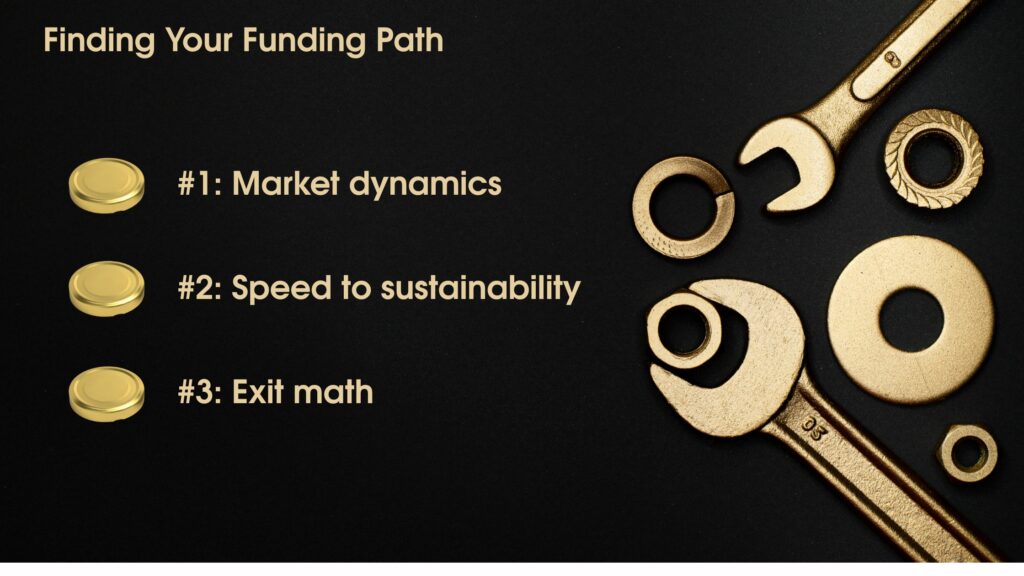
The secret lies in your answers to three questions:
#1: Does Your Market Have Winner-Take-All Dynamics?
Winner-take-all markets heavily penalize a capital efficiency strategy. Does your market demonstrate:
- Compounding effects: Does each customer, data point, or production run make the product better or cheaper for everyone? Telephones and fax machines, social media platforms and battery manufacturing all exhibit this trait: every new customer, user, cycle or production run improves results for everyone. If your business has compounding effects, the leader’s advantage accelerates over time. Second place becomes a death sentence.
- High switching costs: Once adopted, do customers stay locked in? Batteries designed into vehicle platforms, or energy equipment embedded in huge manufacturing plants require massive costs to switch. Which means early market share becomes durable market share.
- Historical consolidation: If adjacent or analogous markets to yours show patterns of consolidating to 2-3 dominant players, rather than fragmenting into many profitable companies, chances are you’re operating in a capital game condition.
In reality, most markets aren’t purely one or the other. When you’re in the messy middle, you can lean towards the efficiency game because the biggest downside of under-capitalizing in a fragmenting market is slower growth. But the downside of over-capitalizing is a cap table that makes realistic exits feel like failures, with investors pushing for outcomes the market can’t support.
Question 2: Can You Reach Sustainability Fast Enough?
As I talked about in my previous post, the litmus test for playing the Efficiency Game is whether your startup can achieve $2-3 million in annual revenue in 2-3 years with a small raise, say under $4-5 million and turn cash flow positive around the same time. If you can, then you’ve earned the option of being able to survive indefinitely without additional funding. This changes your negotiating position. You can raise from strength or choose not to raise at all.
If you can’t, then you’re in a capital-intensive business by definition. The Efficiency Game isn’t mechanically possible. This is just reality. FDA trials cost millions. Some hardware requires pilot plants. In this case, the honest answer is you’re in the Capital Game whether you want to be or not. Plan accordingly.
Question 3: What Does the Exit Math Actually Require?
This is where most founders get lazy, throwing inflated TAM numbers on slides without thinking through what they imply.
Work backwards from realistic outcomes. In fragmenting markets, successful companies typically capture 5-15% of their addressable market. In consolidating markets, winners capture 30-50%.
Do the math. If your realistic TAM is $500 million and you can capture 5%, your exit is likely around the $50 million mark (e.g. 2x of your revenue of $25 million). With Efficiency Game ownership (50%), that’s roughly $25 million before taxes in your pocket. With Capital Game ownership after multiple dilutive rounds (10-12%), it’s closer to $5-6 million. The efficiency path is obviously superior, but only if the market actually fragments.
If your realistic TAM is $15 billion and the market shows consolidation dynamics, winners will exit at $2 billion or more. A 5% stake in a $2 billion exit is roughly $100 million, without accounting for how investor preferences are set. The Capital Game is required to compete for that outcome, and the dilution is worth it.
Making the Call
The key to making the right call is to deeply understand what the winning dynamics are in your market. If it’s an emerging new field, like with many deep tech startups, you’ll need to look at other historical examples for guidance. The way many large industries like railway transportation, phones or even airlines evolved have many instructive lessons.
Three things to keep in mind as you chart your path:
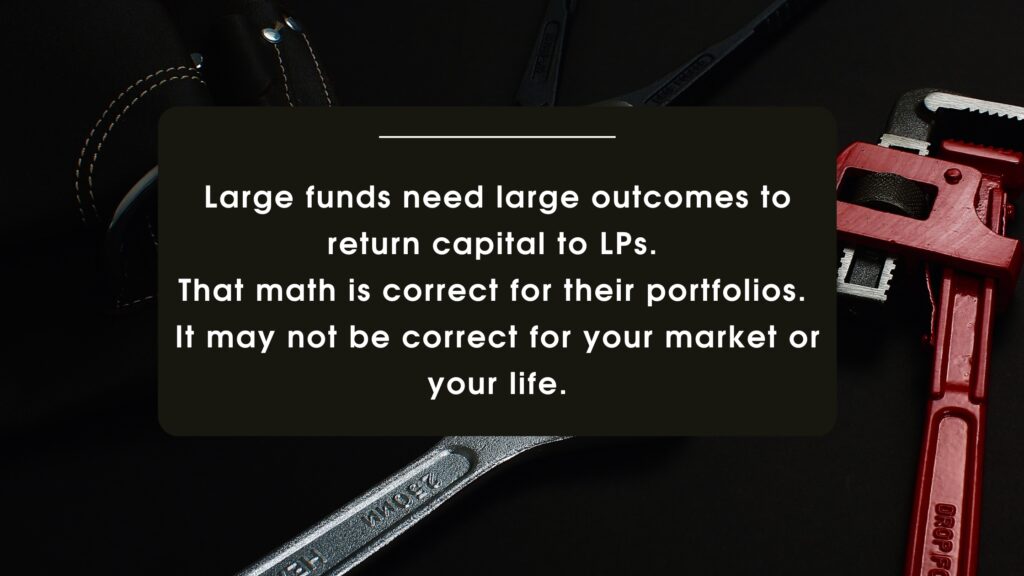
- The venture ecosystem has an institutional bias toward the Capital Game. Large funds need large outcomes to return capital to LPs. That math is correct for their portfolios. It may not be correct for your market or your life.
- If you have any option, the Efficiency Game has a better likelihood of landing more dollars in your pocket, and in a shorter time frame
- If you’re unclear or the market is emerging, it will pay off to see if there is any way to shape your market to reward an Efficiency Game.
Your market may not give you a choice.
Diagnose first. Then commit fully. The founders who struggle are the ones who straddle, raising venture money but operating with a bootstrapper’s mindset, or staying lean in a market that rewards aggression.
Do you know which game tilts your odds to winning?





erythromycin eye drops
erythromycin eye drops
lasix water pill
lasix water pill
generic mobic 15 mg
generic mobic 15 mg
lasix medicine for fluid
lasix medicine for fluid
vibramycin
vibramycin
kamagra jelly benefits
kamagra jelly benefits
sildenafil tablet dosage
sildenafil tablet dosage
vardenafil chewable
vardenafil chewable
vardenafil price philippines
vardenafil price philippines
doxycycline dosage for periodontal abscess
doxycycline dosage for periodontal abscess
terbinafine risks and side effects
terbinafine risks and side effects
terbinafine for thickened nails
terbinafine for thickened nails
ivermectin dermatology overview
ivermectin dermatology overview
minoxidil usage guide
minoxidil usage guide
avanafil contraindication medical restrictions
avanafil contraindication medical restrictions
vardenafil vs sildenafil onset
vardenafil vs sildenafil onset
orlistat medical exclusions
orlistat medical exclusions
penicillin allergy pediatric
penicillin allergy pediatric
Understanding Sildenafil Metabolism
Understanding Sildenafil Metabolism