
A few weeks ago, I wrote about how the way you frame your idea can make or break investor receptivity before they even glance at your deck.
Around the same time, I was working with talented STEM founders gearing up for raises. These were people with serious expertise, real traction, and compelling products. But something was off and I struggled to pinpoint the precise problem in a way they could be fixed.
So I ran a review of multiple simulated investor interviews, line by line, question by question, to see what was happening beneath the surface. Immediately, patterns started popping up:
- Science-bombing: Too much time spent on the science, engineering, their mission or a personal story. Zero signals on their fitness as fundable CEOs.
- Weak-speak: Hedging, uncertain, diffident language that destroys investors’ perception of founders’ competence. Too many “I think… maybe… sort of… hopefully…” hedges.
- Runway-rambling: Technical, verbose and unstructured responses to simple questions like “Why will customers select your product over the competition?” buried big headlines.
When these issues distort your message, you’ll lose investors within minutes. Once lost, investor interest is hard to ever get back, now or in the future.
Why Domain Language Fails Even When The Product is Great
So now you can see the hidden patterns, what drives these communication failures?
Don’t Impose a Cognitive Tax
An investor asks a founder a simple question early in the conversation: “What exactly does your product do?”
What they get is a complex workflow, three layers of architecture, and a set of industry standards they’ve never heard of. Five minutes later, they still don’t know the one thing they asked.
Investors won’t google the answers or decipher your jargon. They don’t have the time or mental energy to decode your domain just to understand your pitch. Rather than pay this cognitive tax, they’ll mentally disengage and move on to the next thing.
Mission and Mechanics Don’t Translate to Money
A founder starts pitching. The investor asks, “Why does this matter to the buyer?” and is immediately subjected to an impassioned speech on the mission: why the problem is painful, why the world needs this. Or a master class on the science behind the product.
RIP, fundraise.
With every question they ask, investors are looking to fill a mental spreadsheet in real time:
- How big is this market?
- How urgent is the problem economically?
- Who actually pays, and why?
- What steers buyers to this product over what they’re doing today?
Mission, features and science don’t populate any of those cells unless they tie to buyer motivation, i.e. the money part.
Features Aren’t Strategic Advantage
The same pattern shows up with features. Founders proudly explain the elegant workflow, the clever engineering, and the chemistry. Meanwhile, the investor still doesn’t know:
- What’s the moat? What makes this hard to copy?
- What keeps buyers locked in?
- What protects margins over time?
If you don’t answer those questions, they fill the answers themselves, usually with assumptions that hurt you:
- This will be hard to sell.
- This isn’t defensible.
- This founder may not scale.
No matter how strong your business, the investor’s mental spreadsheet only reflects what you say, not what you meant.

The 5M Framework: Your Translation Toolbox for Investor-Ready Language
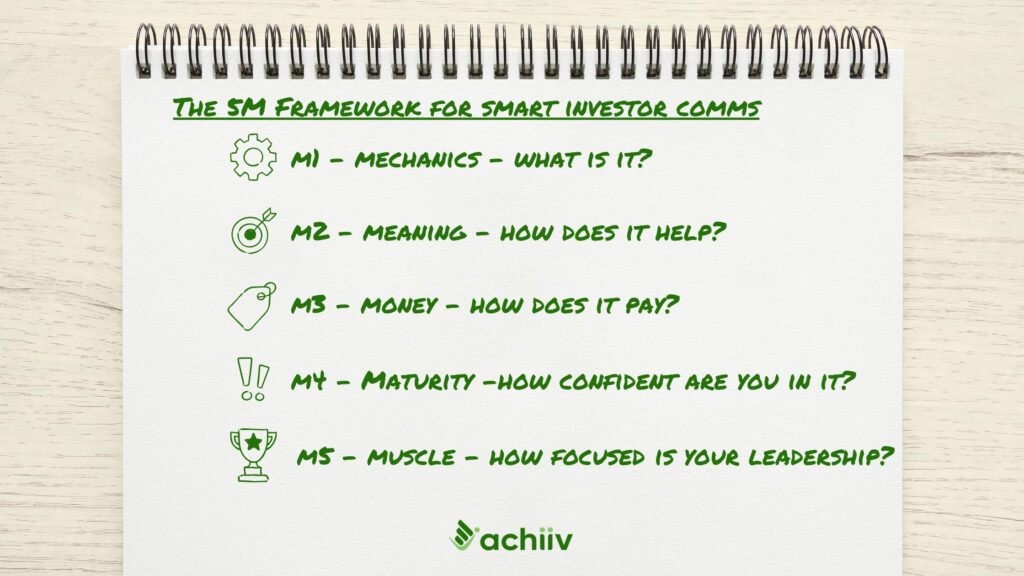
So now you know that translation is key to fundraising traction. To make it actionable, I developed the “5M” framework. Here’s how it works:
- M1 – Mechanics: Start with the factual technical description of what your thing is or does, without interpretation. For example, product, workflow, the science or architecture. The risk is if you stop here, you force investors to do the decoding for you.
- M2 – Meaning: Explicitly connect the mechanics to an operational, emotional, or strategic problem that is solved for the buyer or user, e.g.,time saved, risk removed, process accelerated or accuracy improved. Without this, the investor can’t see why your buyer should care.
- M3 – Money: Take the solved problem and show how it improves the economics. Make the commercial logic obvious and compelling, in the form of lower costs, higher revenue, or greater safety. This is how the investor sees why someone would take out their checkbook to pay.
- M4 – Maturity: Take a hard look at the language. Transform weak framing like, “maybe”, “hopefully”, into a confident stance with direct sentences, “We plan,” “We expect,” “Our data shows”. Emphasize decisive framing and clear prioritization. If mechanics, meaning and money are what you say, maturity is how you say it.
- M5 – Muscle: Enhance the structural strength of your answer. This is the CEO discipline of leading with the conclusion (not the backstory, using logic before details, being crisp, structured, and brief and speaking in a way that reduces cognitive load. This is your communication operating system that makes investors think, “This person can run a board meeting. This person can sell. This person can lead.”
Put It Into Action, See The Impact
The 5M Framework turns domain-heavy answers into clear, commercial, confident CEO communication quickly and easily.
Here is a practical manual to implement it before your next investor call:
Step 1: M1 – State the Bare Facts:
- Write one factual sentence that describes what the product does.
“We detect X.” “We automate Y.” “We analyze Z.” - Remove adjectives and claims (“advanced,” “cutting-edge”).
- Convert process explanations into one verb.
- Test: Could an intelligent outsider understand what this thing is?
Step 2: M2- Show Why It Matters
- Pick the single biggest pain you address (time, accuracy, throughput, risk, compliance).
- Rewrite the improvement in plain buyer language.
“Projects finish in hours.” “Downtime goes away.” “Error rates drop.” - Tie it to an operational or strategic frustration buyers already feel.
- Test: Would a buyer nod instantly?
Step 3: M3 – Tie Meaning Directly to Money
- Identify the economic driver your solution affects: Cost, revenue, margin, productivity
- Quantify impact with the cleanest, most defensible number you have
- State it in one line: “This reduces downtime by 25%.” “This cuts energy use by 20–30%.”
- Test: Would a CFO see the ROI immediately?
Step 4: M4 – Infuse Clarity and Ownership
- Find and replace hedging phrases with confident ones:
- “I think…” → “Our data shows…
- “We’re trying to…” → “We’re executing…
- “Hopefully…” → “We expect…”
- Remove apologies and self-corrections:
- “Sorry, let me restart…” → “Let me give you the direct answer.”
- Switch to evidence-led statements: “We believe…” → “We’ve validated…”
- Practice until it feels natural — clarity is a habit.
Step 5: M5 – Use CEO Structure, Not Stream-of-Consciousness
- Lead with the conclusion. Always start with the direct answer.
- Supply the logic. Two sentences max explaining why.
- Offer evidence only if asked. Data points, pilots, benchmarks.
- End with a bottom line. “Here’s the takeaway…” “The core economic driver is…”
- Test yourself: Record your top 10 answers. If the point arrives after the 50% mark, rewrite it.
So the founder who used to say this:
“Well… so basically what we’re doing is, um, we’re kind of taking different kinds of biological data — like genomics, proteomics, and metabolomics — and running it through this pretty advanced machine learning pipeline we built. It’s still evolving, but the idea is that it can pick up subtle signals that humans might miss.
….more domain words….(investor was checking email and missed what you said)
We think it could save money down the line, but we don’t have that quantified yet. Right now we’re focused mainly on getting the accuracy as high as possible.
So yeah… the technology is really exciting. I can walk you through the workflow if that’s helpful.”
Now sounds like this:
- “We’ve developed an algorithm that identifies early disease signatures by analyzing multi-omics data streams in real time.
- This gives clinicians a single, integrated view of patient risk weeks earlier than standard testing.
- Earlier detection reduces the cost of care per patient by 20–40% and prevents expensive downstream interventions.
- Our data shows the model consistently identifies risk signals at least two clinical visits before current standard diagnostics.
- We move detection upstream. Upstream detection lowers cost of care and increases provider throughput. That’s the business value.”
Which kind of founder would you rather be?