

Lately, I’ve been seeing more and more LinkedIn posts dangling easy fixes for founders looking to raise: Curated lists of 3,000 VC’s. Fast, effortless investor-matching. Instant access to investor platforms. When you’re a struggling founder, this sounds smart and logical. If fundraising, like sales, is a numbers game, then you should reach more prospects to close more deals, right?
Yes and no.
The problem is, if not done right, much of this increased activity only leads to greater rejections, not necessarily to better odds of getting funded. Serious investors see hundreds of deals and need to kill 90% of them fast. When faced with this volume, their focus is not on finding winners. Their goal is to eliminate as many of these as easily as possible, without putting too much work into them, so they’re only left with a small pool of high quality deals for serious consideration.
So, putting more and more effort into jazzing up your pitch or reaching out to more investors will make no difference if you’re neglecting the stuff that will get you disqualified from the game where it counts.
Engineers use a particular way of thinking to ensure that the big structures they’re building don’t collapse under pressure. They use “failure mode” thinking to identify critical failure points that present the greatest risk of collapse. Then they focus resources on ensuring that these critical links don’t crumble when at full load.
This same thinking is needed for your fundraising. Without it, the greatest preparation on some parts of the process, like your pitch deck, won’t help you if you haven’t addressed the potential points of failure, like the details of your business model, that could kill your chances of getting funded.
The Three Failure Modes
Investors are assessing your startup against three big filters. These filters are active at every step, and investors use them with increasing depth to initially eliminate, then finally decide if you’re the lucky one that gets funded.
Failure Mode #1: Fit
Most investors have a clearly defined sand box, typically sector and geography, stage and check size and some investor-specific criteria: e.g. won’t fund solo founders.
These are hard criteria they’ll use to reject all deals that don’t fit. Many of these are clearly outlined on their website or application materials. Some require detective work to tease out, like where they are in the life of the fund.
Others are invisible. Some groups won’t do SAFE’s or fund LLC’s. Others won’t consider deals unless IP is fully assigned.
Fit is usually the largest source of rejection. It’s also silent because there are just too many applicants for investors to respond to, so at best you may get an autoresponder with no usable feedback.
Failure Mode #2: Fundamentals
If you pass the fit test, investors start poking under the hood. Fundamentals are what separate thoughtful founders from “pitch-preneurs” and “solutioneers”. If your idea is sparse on details on how your product makes money, gets to customers’ hands, and how the business will grow and scale, you’re an easy target for rejection on fundamentals.
This is where most first-time STEM founders struggle. They fall in love with the technology and ignore the “boring, low-brow” business part. Or they think a big TAM (target addressable market) will take care of the business questions. If your TAM is $5 billion but you can’t explain how you’ll make your first $50,000 in sales, you’re not getting funded.

Failure Mode #3: Financial Sense
The specifics of your raise are a big deal for investors, far more than most founders realize. You can pass fit, demonstrate very strong fundamentals, but if the deal terms don’t make financial sense, your deal is dead on arrival. Here’s what they’re checking for:
- Security and deal structure: Do they like the security (e.g. SAFE, convertible note)? Is the valuation typical for this stage and for this region? Valuations on the coasts (San Francisco and New York / Northeast) are much higher than in the heartland.
- Milestones: Is the next value inflection point clearly identified and is this round enough to get you there?
- Capital roadmap: How many more rounds will this take before investors see an exit? What are the chances you’ll raise that, and how much dilution will they have to take?
- Return potential: If investors put in “x” dollars now, what’s the path to 5–10x return?
If the answers to these questions aren’t immediately clear and unambiguous from your pitch deck, it’s easier to pass than try to “fix” your round.
Engineering the Fix: How to Eliminate the Failure Modes
This list looks scary. But fixing it isn’t a huge all-out effort. Fixing the few “fatal flaws” gives you a huge lift. After that, it’s an ongoing process of debugging issues starting with the most significant. You’ll soon develop a good intuition for what that needs to be.
Surviving the Fit Filter: Your Raise Profile
The fastest way to avoid this failure point is to do basic homework. But this is a huge lift. To make it easier, build a “Raise Profile”:
-
- Clarify your funding specs: List your sector, sub-sector, stage, geography, amount, security type, founder profile, business model, customer type, technology.
- Build hashtags: for example:
- Sub sector – e.g., battery technology within cleantech
- Business model – e.g. SaaS, DTC
- Customer type – e.g. enterprise, OEM
- Technology – e.g., synthetic biomanufacture
- Founder type: Solo founder, tech founder, repeat founder
- Pre-screen every investor: Evaluate investors against your raise profile manually via a spreadsheet. Alternatively, optimize your parameters if you are using a smart investor matching platform.
- Track fit systematically: Track outcomes for each investor so you can refine your target list with every cycle.
Bonus: Lead your deck with “Here’s who we are. Here’s what we’re raising. Here’s the type of investor we’re looking for.”
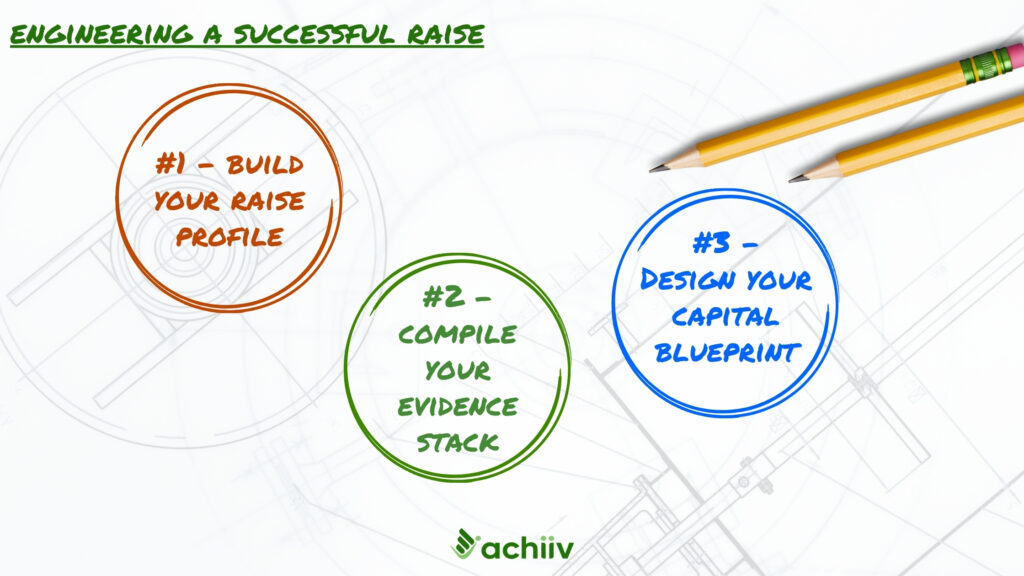
Acing the Fundamentals: Your Evidence Stack
What gets serious investors interested is the unglamorous details most founders skip. Investors lean in when the business details are concrete, tested, and real. To build your fundamentals:
- Extract every claim and assumption: Go through your pitch materials with a fine-tooth comb. Include questions investors have asked in the past. Identify each major assumption or promise that will drive your success
- Build your evidence stack: For each claim, provide credible proof. This could be data, traction, experiments, or industry benchmarks.
- Do a stress test: For the major assumptions, ask and answer: Where could we be wrong? What’s the worst that could happen? How would we recover?
- Integrate proof into materials: Include the foundational proof points organically into your pitch deck or in a read-ahead document so you control the narrative before the meeting.
Many founders experience this grilling for the first time in a live investor conversation. Be smart. Prepare beforehand. Save yourself another invisible rejection.
Demonstrating Financial Sense: Your Capital Blueprint
Investors want to see a clear story arc with your raise. They want to easily see a clear purpose, a realistic length, and a logical bridge to the next round. Line up the numbers, milestones, and terms in a way that makes the next leap feel inevitable. To do this:
- Define your raise rationale: Articulate a concise statement of exactly what this round will achieve (prototype, pilot, regulatory clearance), realistic timeline, interim prerequisities, and a high-level cost breakdown.
- Craft your capital plan: Demonstrate you understand total capital needed to exit, high-level view of raises needed by round and approximate timing, and valuation increases at each stage
- Check and align deal terms with norms: Choose a security type that matches stage and investor preference, research typical valuations for your sector and geography, and adjust expectations accordingly.
Misaligned terms rarely sink a good deal by themselves — but they can be the push that sends a borderline decision into “pass” territory. Tighten them now, and you’ll have one less strike against you.
Making It Happen: Simple Steps
You can apply this thinking no matter where you are in your raise process. Even if you’ve reached out to investors, there are learnings you can leverage in the future. Here’s how to get started:
- Build or refine your raise profile.
- Craft a simple investor interview questionnaire covering the fundamentals of your business. Use your favorite AI tool. How well and succinctly can you answer them?
- Define your capital blueprint. Can you quickly answer how your current raise fits into the overall picture? What will this get you? When is your next raise? How much will you need in total? Over what time frame? When can you exit? How?
- What’s the 30-second pitch your advocates can use with their peers to sell your startup for investment?
Engineers know that one overlooked flaw can bring down the whole system. As a founder raising money, perhaps one fix can take you from frustration to fully funded!