
Press play to listen, or check it out on your favorite platform:
YouTube | Apple Podcasts | Spotify | Google Podcasts | iHeartRadio | Amazon Podcasts | Spreaker
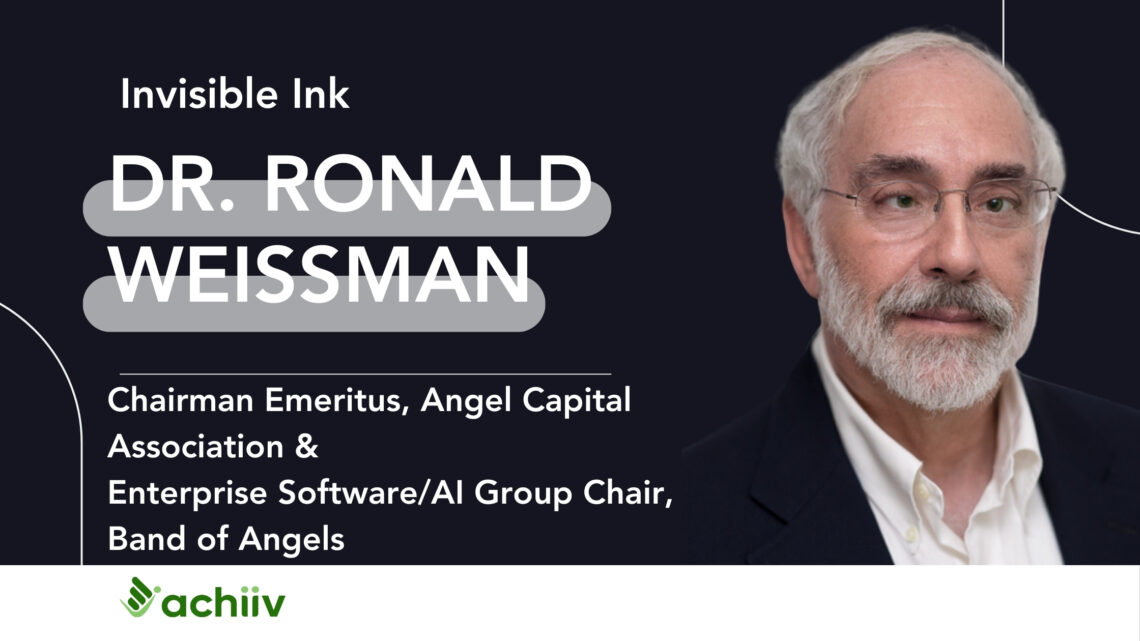
About Dr. Ronald Weissman
Dr. Ronald Weissman is a venture capitalist and angel investor with more than 30 years of experience in high technology investing and management. He advises investors, startups, mature companies and regional and national governments on investing in AI, private capital trends, startup hub success factors, venture economics, fundraising and valuation, and public policy.
He was recently Chairman of the Angel Capital Association, North America’s principal organization for professional angel investors and remains on its Board of Directors. He was formerly Chair of the ACA’s education committee and is the author of the ACA’s two courses on Early-Stage Boards of Directors as well as its course on Managing and Mitigating Startup Risks.
Weissman is also senior advisor and a member of the investment committee for Neva, the venture capital arm of Intesa San Paolo, one of Europe’s largest banks (focusing on healthcare, energy and technology investing in Europe, the US and Israel).
For the past nineteen years, Ron has been Chair of the Enterprise Software/AI Group (formerly the Software Interest Group) at the Band of Angels, Silicon Valley’s oldest technology angel organization. He invests in AI, analytics, health IT and vertical market software and across a variety of deep tech industries.
He spent seventeen years as a partner at Apax Partners, a global VC/PE firm where he focused on technology and cross border investing across Apax’s investment teams in the US, Europe, the UK, and Israel. Between his overlapping VC and angel careers, he has invested in or provided fundraising, corporate growth, and governance advice to more than seventy startups and has served on more than forty private company boards. Recent exits have included Taulia (invoice arbitrage, sold to SAP in 2022) and Gainsight (customer experience management, sold to Vista Equity Partners in 2021).
He has spent the past decade teaching investing best practices to angels and regional and national governments in startup hubs around the world, including Australia, Armenia, Chile, Georgia, Germany, Israel, Italy, Japan, New Zealand and Ukraine. He writes and speaks frequently about venture and angel investing, AI investing and valuation trends, capital models, and regional startup hub best practices. He has also lectured widely about the impact of AI on key markets including energy, financial services, the law, and healthcare and has keynoted major conferences on AI and related technology trends, including MIT Israel’s 25th anniversary conference.
Prior to becoming an early-stage investor, he was Chief Marketing Officer and head of Investor Relations for Verity, then the market leader in corporate information retrieval. During his tenure the company won Large Cap Turnaround of the Year, as it grew its market cap from $35M to more than $1B. Earlier, he was a direct report to Steve Jobs at NeXT, where he managed global marketing strategy and European marketing. Prior to NeXT he spent twelve years working for civilian and other federal agencies including the Department of Energy, DoD and the Department of Transportation, concurrent with professorships and university computing management roles at the University of Maryland and Brown University.
He received his BA, MA and Ph.D. degrees from the University of California, Berkeley and is a former Fulbright Scholar (Italy) and has written extensively on the social history of Renaissance Florence. He is also the recipient of Keiretsu Forum’s Lifetime Achievement Award for his work in angel education.
Episode Highlights
- Why some founders immediately feel investable—even before the deck comes up
- The question investors are really trying to answer in the first few minutes
- What years of looking at deals teaches investors that pitch contests never do
- Why getting a fast yes from an investor can be more dangerous than a slow no
- The part of diligence most founders don’t realize they’re being evaluated on
- What investors listen for when founders describe their market—not their product
- How investors tell the difference between a strong pitch and a strong business
- When a funding path helps you—and when it starts working against you
- The moment investors decide whether they want to work with you long-term
- What a founder’s roadmap reveals that no slide ever says out loud
- How deal structure shapes the relationship long before anything goes wrong
- The shift in thinking investors expect from founders aiming to build category leaders
Links and resources
- Angel Capitalist Association – A professional association representing angel investors and publishing data on angel investing trends.
- SBIR Grants (Small Business Innovation Research) – Non-dilutive government funding programs supporting early-stage technology and R&D startups.
- Crunchbase – A startup and investor intelligence platform used for researching investors, sectors, and board participation.
- Band of Angels – A long-standing angel investment group referenced in the context of early-stage deal evaluation.
- Carnegie Mellon University – A leading research university whose technologies contributed to early operating system innovation.
Interview Transcript
Shubha K. Chakravarthy: Welcome to Invisible Ink, Ron, and we’re so excited to have you here today.
Ron Weissman: It’s a pleasure to be here.
Shubha K. Chakravarthy: So I’ve been meaning to have this conversation for a long time. I’ve got a long list of topics lined up. But before we get started, I have to ask you about the story where you worked for Steve Jobs. Is there something that you’d like to kick us off with in terms of your most memorable experience?
Ron Weissman: Oh, well, Steve was absolutely the best critic I’ve ever seen in the world, but this was generally about everything. So imagine the scene: we are opening our research center affiliated with Carnegie Mellon University in Pittsburgh. Steve had a terrible US Air flight, and he’s standing up at lunch to talk to the leaders of the Pittsburgh business community. He said, “If you want to be a first-class citizen, you need to have a first-class airline.” That was probably the worst opening comment I’ve ever heard from a keynote speaker.
Shubha K. Chakravarthy: And what was the reaction?
Ron Weissman: But he redeemed himself by looking very seriously at some of the best technologies coming out of Pittsburgh, which were truly magical. In fact, much of our operating system came from Pittsburgh. So it all ended up well.
Shubha K. Chakravarthy: Great. That’s a fantastic way to start. So you’ve had tremendous experience across the entire early-stage industry. You’ve been a VC, you’ve been an operator, an angel. What has been the single biggest theme that has come up across all of these experiences?
Ron Weissman: Well, let me mention the theme I’m going to be using throughout today’s conversation, and that is I need to be just as excited by people who are themselves just as excited about building the business as they are about building the product. That’s kind of my core investment theme I’ve been pushing recently.
Shubha K. Chakravarthy: So walk me through it. What does that mean in reality when you’re talking to a founder?
Ron Weissman: It means that the founder needs to be building the business and the business strategy into everything he or she does—not as an afterthought, not as finally finding a partner—but this needs to be from the get-go. How am I going to make this work?
How am I going to create a market winner? How am I going to pay back my investors? How am I going to reward my team? How am I going to be able to grow fast, become a major presence in this industry, not just with a great product, but with a great team and with a great outcome?
Shubha K. Chakravarthy: And how is that different? You said that’s going to be the theme today. Has that evolved over time? Has that changed?
Ron Weissman: Well, there’s lots of change going on right now in the early-stage community, and there’s a lot of change going on in the overall economy that’s impacting the early-stage ecosystem. Right now, it is very hard to get a job if you are not a credentialed AI wizard.
I think that some of the leading hiring companies for talent are hiring about 25 percent less this year than they had in the past. What this means is there are a lot more startups out there because people are saying, “Hey, what the heck, I might as well realize my startup vision.” But that means many of those people are unfamiliar with having run, let alone built, a startup. And so we have to exercise and explain the basics to them. I’m seeing a lot more first-time, very inexperienced CEOs than I have in the past.
Shubha K. Chakravarthy: Is that a huge change or just a gradual change?
Ron Weissman: It’s a pretty big change. We saw some of the same things happen in 2002–2003. Certainly, we saw some of the same things happen in 2001–2002. The good news is that angels did not hold it against brand-new CEOs. In fact, there’s been a steady increase over the past decade in angels funding first-time CEOs with no experience. So that’s very good. At the same time, the quality of deal flow is not as good as it has been.
Shubha K. Chakravarthy: So what does this mean for a first-time founder who’s now coming to seek their first outside funding round?
Ron Weissman: Have mentors. Gain experience before you enter this world. Have business mentors who can help guide you. Think about finding a partner, a teammate, who is your business founder from day one and who has had some experience building a successful company in the past.
Shubha K. Chakravarthy: Got it. That makes sense. And I want to start digging into that a little bit in terms of the early-stage funding landscape. I’ve heard you make amazing presentations before where you’ve painted a picture of what the early-stage funding landscape looks like.
So if you look at the landscape today for a first-time founder who may not understand the difference between VC versus angels versus crowdfunding, how would you paint that picture so that they can think intelligently about the funding landscape?
Ron Weissman: I think one of the questions you also wanted me to think about was what’s happened in the early-stage landscape for the past decade, so let me answer the question that way. I’m not sure this is good is what I call the industrial model applied to early-stage funding.
You go first after friends and family, then you go to an incubator or an accelerator, then you go to angels, then you go to early-stage VCs, then you go to later-stage VCs. Much of the groundwork is established by the incubators and the accelerators. On the one hand, I am seeing both less experienced CEOs, but CEOs who have been in this market for a while are more and more sophisticated.
An experienced CEO tends to know lots about venture, tends to know lots about angels, and so forth way more than in the past. At the same time, this has led to an unbelievably boring set of pitching contests where everybody sounds the same, uses the same clichés, uses the same language, uses the same structure—kind of pitching by paint-by-the-numbers. Instead of originality, I’m seeing a lot of very similar, very dull, very dry pitches. I think the industrial model has led to a foreshortening of creativity.
Shubha K. Chakravarthy: And what does that mean for you as the investor sitting on the other side, and therefore what are the implications for me as a founder sitting on this side?
Ron Weissman: I was asked last week, “What is the one thing a startup can do to really impress you?” My answer is: teach me something I didn’t know before. Show me some insight you have about the market. Excite me with a new challenge, a new opportunity. Tell me something I didn’t know before. Give me enlightenment, give me insight, and that will get me really excited.
Shubha K. Chakravarthy: Basically what you’re asking for is domain mastery and insight into a specific corner of the market that is not commonly available.
Ron Weissman: Exactly. Not only domain knowledge, but direct participant knowledge enough so that you have a pain point or an insight that I certainly wouldn’t know because I’m not a market participant, but that you have lived through it, and it’s causing you to start this business.
Shubha K. Chakravarthy: So I’ll just go back and think about some of the founders I’ve seen and worked with. Usually it’s the “I experienced this pain and I didn’t find the right solution, so I’m doing this,” which sounds like a typical, to me it sounds like a boilerplate way of introducing pitches. That seems to go against what you just said. Are there examples of founders that have done it well, or aspects of that process that have gone well for you?
Ron Weissman: Oh, absolutely. One of my most memorable pitches ever was two guys who came to me and talked about the impact of earthquakes on mere mortals driving across a bridge, for example, and said, “What if we could detect an earthquake two to three minutes before it happened?” I said, “If you could do that, you could be saving lots of lives and really changing the trajectory of hundreds or thousands of people.”
We talked about that for a while, and they told me about something I’d never heard of called P-waves, which is a pressure wave that you can detect three or four minutes before an earthquake hits. Again, they taught me something. They excited me. They gave me a different take on the world, as opposed to “we’re solving the dating problem for people from Afghanistan.” I love that. So teach me something new and different and give me an insight into a piece of the world that I didn’t know about.
Shubha K. Chakravarthy: So I can buy that. That would get you excited. How does that correlate to making a good investment, though?
Ron Weissman: There’s a long process after I get interested in a deal. We call that due diligence, but really it’s one to three months of us working together to figure out how well your business strategy is likely to pay out. This is about pattern recognition, since I’ve probably seen 20,000 prior deals.
It’s all about learning how to work together and whether we can work together. I think it’s kind of funny when a funder writes a check over a morning breakfast when we just met the startup, never having seen them before, because you’re both missing that deep interaction, which might say this is not an appropriate partnership, or it might say this is going to be a world-class partnership.
Shubha K. Chakravarthy: Have you seen examples where somebody met for breakfast and wrote a big cheques, and have those worked out?
Ron Weissman: I don’t like to say bad things about other people, but back in 2000 this was very common. Whenever markets pick up, writing those cheques over breakfast becomes increasingly popular because of fear of missing out. “I want to nail this one down right now,” having done no work on what could be some of the fatal flaws relating to the company, its markets, and its team.
Shubha K. Chakravarthy: I can understand the risk to the investor. You don’t know who you’re dealing with. But what about the founder who takes that check? What are the risks to him or her?
Ron Weissman: First of all, investors come in all shapes and sizes. Some investors are extremely control-oriented, and they have a vision for what you ought to be doing. That may not be your vision. They may have had an idea in a prior life and want you to fulfill that. They may have a sense of markets that has nothing to do with what’s good for you or for the company.
Some investors can be too hard-nosed and too forceful, and that’s something to ferret out. Other investors can be the smartest guys in the room, and you don’t want to work with them. Other investors can have a hidden agenda. There are some investors who pretend to be investors, but they’re really running marketing agencies and want you to use their marketing agency. So you need to do diligence on us at the same time we’re doing diligence on you.
Selecting the Right Investor
Shubha K. Chakravarthy: So on that point, what would you say is the single biggest mistake you see founders make in selecting their first investor?
Ron Weissman: Not really understanding what the investor’s motivations are, or what the end game for the investor looks like.
Shubha K. Chakravarthy: So can you say more about that? What are they missing?
Ron Weissman: Some of the issues with investors are, if you’re talking to venture capitalists—and this is more them than angels—VCs have invested via funds. Those funds have a ten-year life. Now, they can keep the fund going longer, but they have to basically say what they’ve done within the scope of that first ten years. Did they achieve a 2x, a 3x, a 4x on their money, which is what they tell their limited partners?
So if a VC is investing late in the fund—let’s say investing in year seven—they’re going to be pressuring you well before you’ve had a chance to achieve metrics and milestones. They want you to exit so they can show return on capital to their investors.
So if you don’t know the mechanics of their fund, for example, are they investing in the first three years or the last three years, you may have a very, very bad outcome in terms of what the VCs have to do themselves.
Shubha K. Chakravarthy: And that’s a great example, and I want to dive into the bigger picture. But on that specific topic, this is not something that’s easy for a founder to find out, right? How would I find out where you are?
Ron Weissman: You go on the website of the investor, and they typically list when their funds started. Or you can look at their press releases to say, “Okay, I’m investing in Happy Valley Fund Four. It started in, let’s say, 2016. My God, it’s the tenth year of the fund. They’ve started investing now. I’m toast.” Or they raised the fund in 2024, which is great. That’s all public knowledge.
Shubha K. Chakravarthy: You mean the LPs, right? Not the funds themselves?
Ron Weissman: The funds themselves.
Shubha K. Chakravarthy: The funds themselves. So you do the research on the funds.
Ron Weissman: And by the way, about the first question you should be asking any VC is, “How old is your fund? When did it start investing?”
Shubha K. Chakravarthy: So to take one step back, I’ve talked to a lot of founders where they seem to understand the VC world better than they understand the angel world.
VC vs. Angel Funding
Shubha K. Chakravarthy: Can we just take a quick side tour and help us understand the early-stage funding landscape? We understand VCs. What’s the difference between VCs and angels, and how should founders be thinking about who to work with as their first source of funding?
Ron Weissman: Okay. Well, the old joke is that the VCs lose other people’s money, and angels lose their own money. There is a bit of truth to that. Typically, we want to get paid for the risks we’re taking, and angels are taking an earlier-stage risk by and large than VCs are.
So what angels are looking for is anywhere from, let us say, a 5x to a 20x on their money. I can explain why those numbers work, because we’re taking early-stage risks. The assumption is that most of our deals will fail, and we build that into our own computation. So when we say we want, let’s say, a 10x from you, that’s because we assume that nine out of ten deals fail, and we want a big multiple so that we can pay ourselves back for all the mistakes we’ve made.
VCs have the same logic, although their failure rates are later stage, so they shouldn’t be as dramatic as ours. So a VC may be happy with a 3x, a 4x, or a 5x, where an angel is typically in the 10 to 20 to 30 x range, given how many of our deals, just of life instances, fail.
Shubha K. Chakravarthy: So you talked about angels, you talked about VCs, and of late I’ve seen a lot of other participants coming up. For example, specifically crowdfunding platforms. To what extent are these a real viable option for founders, and for what kinds of founders?
Ron Weissman: Okay. So if you have a physical product that needs to be manufactured, we all understand that you need a fair amount of working capital upfront to do that, and crowdfunding provides that. Crowdfunding is best for tangible physical objects.
If you’re a software vendor and you’re going to crowdfunding, you are probably going to disqualify yourself from raising follow-on funding, because for normal software businesses, if you can’t raise money the normal way, why are you going to people who have no investment experience whatsoever?
You are probably very naive, and you cannot come back into your market in a ten-, twelve-month period because of the rules of crowdfunding. Why are you doing this? You must not be very good. Physical products are entirely different.
Shubha K. Chakravarthy: So there’s a clear bifurcation. If you have a physical product, particularly consumer-facing, that somebody can touch and feel and have some connection to, that’s clear. Then there’s a bifurcation between angels and VCs. How should I make that decision, and what are the factors I should think about as a founder when I’m going that route?
Ron Weissman: That’s a great question, because the answer does not quickly go to one side or the other. If you need money to grow markets fast, and you need introductions to the global leaders in your market or the customer base, there’s nothing like venture capital to help you grow fast.
If you do not need to grow that fast and you want to maintain more control over your company, then angels are a great way to do that, because we take less. We’ll take fifteen to twenty-five percent of the equity, where VCs are going to start off by taking probably fifty-one percent.
That’s why you can start out with a hundred percent ownership, and by the fourth or fifth round, you as a CEO will be down to eight percent, five percent of the equity, because every investor is going to want to further dilute the existing investors to maintain a decent stake in the company.
So if you want to maintain control, particularly of a family-style business, you do not want to work with VCs. On the other hand, if you really want a global domination strategy, you’re going to need lots of capital, lots of speed, and lots of high-level introductions. Where you overlap is that angels can also make many of those high-end introductions, but we’re less onerous in terms of the capitalization structure we demand.
Shubha K. Chakravarthy: Is there a rule of thumb you’ve seen working well or not working well in terms of how founders make that first decision? Because slice of founders I have worked with, they seem to be more familiar with the VC space and a lot less familiar with the angel space.
Ron Weissman: That’s very true. Well, both VC and angel investing—were black arts, old boys’ club kinds of things, where if you weren’t part of the group, you had no idea how they operate. But we’ve seen the vast expansion of venture capital and the vast expansion of angel capital in the past decade. So in both cases, we are far less mysterious than we used to be.
Shubha K. Chakravarthy: What advice would you give to a founder who doesn’t want to give up control and wants to explore angels? What should they be doing, and how should they be looking at that part of the ecosystem?
Ron Weissman: One of my rules of thumb is that we’re not talking about one simple term in a term sheet. We’re talking about a whole package of terms structuring a relationship between a founder and a VC, or a founder and an angel. You want to look at all of that in the context of what kind of relationship you want or need.
Are you going to need continuous on-site support from the VC, from everything from building your team to building your network to finding your partners? Or are you pretty much convinced you can do much of that yourselves without needing direct intervention of the VC?
How fast do you need to grow? How fast do you need to grow your networks? What kind of exit do you want? All of those things should color your decision about VCs, angels, or self-funding.
Shubha K. Chakravarthy: Got it.
Ron Weissman: I tell founders, do not take venture capital unless you really need it, because this is a devil’s bargain. I speak here as somebody who’s been a VC for thirty years. We will control your life.
Shubha K. Chakravarthy: What does that mean?
Ron Weissman: We take control of the company over to us, because we now have fifty-one percent control of the company.
Shubha K. Chakravarthy: To make this real for me as a founder, it’s attractive to get a big check and all those connections you talked about to the market. What does that mean in terms of what I’m giving up if I go for VC money? Can you talk about tangible things that affect a founder’s life and business?
Ron Weissman: If you don’t perform well for two or three board meetings in succession, you may be gone. We control the hiring and firing of the team, and if we’re unhappy with the performance of the team, we can simply go out and bring in a new team if we want to. Generally, that’s bad practice unless you really have to, but you don’t have job security. You don’t have control, the VC can second-guess any decision that he or she wants to.
The best relationships here are built on trust, where we’re working hand in glove together over the course of our eight- or ten-year relationship. By the way, when you’re doing diligence, you’ll get to know if you can work together. That’s one of the things an extended diligence period helps you with, as opposed to a shotgun marriage.
Shubha K. Chakravarthy: So it sounds like it affects your ability to operate and the degrees of freedom you have at a most foundational level, and everything else flows downstream from the fact that you essentially don’t have job security, or it’s very dependent on near-term performance against aggressive targets.
Ron Weissman: You’re only as good as your last board meeting.
Shubha K. Chakravarthy: Is that true? Is it really that bad?
Ron Weissman: Remember, the VCs have put third-party money to work. When the VC forms a fund, the top investors form the VC’s advisory council, and they help guide the fortunes of the VC firm. They do things like approve extensions to the fund, and if certain partners keep doing bad deals, they’ll be asked to leave by the elder VCs, who are often strongly influenced by their advisory council.
You have lots of people’s money at stake. It’s not just your decision to do what you want. There are rules of the road that must be followed.
Shubha K. Chakravarthy: One more thing on this topic of being as good as your last board meeting. Can you talk about what kinds of things you’re evaluating a founder on as the board representative?
Ron Weissman: We’re evaluating the performance of the company. Are we on track against the business plan? Are we on track relating to cash flow? Are we going to run out of money before the company has proven the milestones it needs to get to the next funding round or to profitability?
How well is the team working together? Are they metrics-driven? Are they detailed enough to worry about when things go wrong or when things go right? Are they understanding what success means? Who on the team has seen success before and is bringing those lessons learned back into the company?
But lots of things, but mostly it’s regular quarterly performance, and even before that, it’s performance against plan on development, on building customer service, on building infrastructure. So we want the company to be well governed, and that means that decisions are fair and open and honest about the things that really matter.
Shubha K. Chakravarthy: So now I can see the difference between first-time founders and experienced CEOs, because the experienced CEOs have been around the block a few times. They know what to expect. Do you see a big difference in performance between first-time founders who raise VC money versus repeat founders?
Ron Weissman: Yes. In fact, the most recent issue of the US Angel Funders Report, published by my organization, the Angel Capitalist Association, has shown now for the past several years that experienced CEOs have a higher success rate than first-time CEOs, enough so that that difference really matters. Even so, on a national basis, angels are still every year investing more in new CEOs than they had in the previous period. So on the one hand, we know that experience matters. On the other hand, we are very democratic and want to give newcomers a chance to succeed as well.
Shubha K. Chakravarthy: And is that showing up in worse returns, or is that just something?
Ron Weissman: That’s doing it in returns.
Shubha K. Chakravarthy: So it does show up?
Ron Weissman: Kind of. What kind of multiple did the company achieve at exit? Did they return the money that was invested? Did they return twice the money? Three times the money? Four times the money? Half the money? That’s typically how success among angels is measured. A lot less formally than the VCs are, who are much, much tougher on how they measure success.
Shubha K. Chakravarthy: Alright. So to the earlier question, you presumably will see a difference in returns between, say, first-time CEOs that you’re funding versus repeat CEOs that you’re funding, right?
And you mentioned that angels continue to fund first-time CEOs because they want to promote talent, whatever the case might be, opportunities. Are you seeing this persistence continue, and if so, are angels shooting themselves in the foot to some extent by doing that?
Ron Weissman: There’s so much of deal doing that involves personal chemistry, random activity, things that just happen. It’s not a science. It’s much more of an art, and much of it has to do with the chemistry between the CEO and the investor.
This is true of all early-stage deals, and there’s no quantification for how you measure that chemistry. So we may be very excited by the idea. We might realize that this person is a great engineering lead but not a business lead, and will vow in the term sheet to fix that and say, “You must hire an outbound business-focused CEO.” That won’t stop us from doing the deal, though.
Impact of Exits on Investment Decisions
Shubha K. Chakravarthy: Got it. So I want to shift gears slightly. You talked about returns and how important exits are. I want to start off by asking what is happening in the landscape, the exit landscape, the IPO and M&A landscape today, that will impact significantly, or is impacting, how angels are viewing investments and how other early-stage investors are viewing investments.
Ron Weissman: That’s an excellent question. Outside of AI, and we’ll deal with that in a minute, but outside of AI, the exit window has been closed for the past four years. Virtually no major exits outside of AI. The window is starting to open now, particularly for AI companies, and we are seeing a lot of activity in M&A for AI companies and a lot of activity for IPOs, again for AI companies.
But the fact that most markets have not been doing well after four years means that there’s a lot of angels who have kind of lost faith and are asking themselves, “Why should I keep investing? I’m in negative cash flow. I’m putting money out. I’m not getting money back.” And the same thing is happening to limited partners in venture capital funds.
They’re putting increasing pressure on VCs: “Where’s all my money going? How come I haven’t seen returns?” This will shift, and this last year, 2025, has already seen some positive developments, but not enough outside of AI for us to start cheering at. Both M&A and IPO have been depressed, except for AI, and 50% of the money in the past year we’ve invested is going to AI companies. For some VCs, probably 70–80%.
Shubha K. Chakravarthy: And what’s happening? Are you seeing anything different on the M&A or IPO or the exit scene in general on the AI side?
Ron Weissman: On the AI side, there’s still an imbalance. More money has gone into AI companies than has been returned from AI companies, but it’s a brighter market right now because we’ve seen a number of successful IPOs and lots of M&A in the past year.
So that is the healthiest segment regarding exits. As I’ve said, if we don’t get exit money, we are less likely to keep investing. And there’s been a radical shift in venture capital towards mega rounds, rounds of a hundred million dollars or more, and many of those are AI rounds.
The money going into that venture capital is largely going into experienced managers. There has been a real radical shift there, just because of how dismal returns have been since 2021.
Shubha K. Chakravarthy: So all of this is adding up to a picture that’s maybe not so great for the first-time founder, especially in an area like deep tech or STEM. Because on the one hand, angels haven’t had any liquidity, so you don’t have any extra cash to invest.
There’s government grants that are very uncertain, and then VCs are kind of concentrating more and more toward experienced managers, large rounds, very sector-concentrated in terms of AI and related fields. What does all of this mean to the first-time founder, and what advice would you give them to say, how should they arrange themselves to maximize their chances of getting funding?
Ron Weissman: Cast the net wide and look at non-traditional sources. There are SBIR grants and other government funding that, the good news is, they’re non-dilutive. And there are many, many different funding organizations and agencies both here and in Europe. But I’d also say one of the most interesting signs of life I’ve seen is private equity.
Private equity wants to be co-investors, particularly in hot sectors. Something like 40 or 50% of all software exits have happened because of private equity buyers, not the traditional strategic buyers of people in your industry. So it’s never too early to start making friends with smart people in private equity who like your domain, like your industry.
Shubha K. Chakravarthy: So even if you’re an early-stage founder?
Ron Weissman: They’re both investing as well as buying.
Shubha K. Chakravarthy: Wow. Okay. That’s the first time I’ve heard that. And are there things you would do differently when you’re building a relationship with a private equity investor versus a traditional early-stage investor?
Private Equity vs. Venture Capital: Key Differences
Ron Weissman: Another great question. The key thing that private equity looks for that venture capital does not is cash flow. The private equity deals are somewhat different, and it takes positive cash flow to create the kind of leverage that allows a PE firm to go in and invest substantially.
So we are less concerned about positive cash flow early on than the private equity people are, but that’s where they live and die. And so for them, EBITDA is their governing religion because they want you to have positive EBITDA, which allows them to take out bigger loans for more of your company.
Shubha K. Chakravarthy: So does it bias them more towards heavy cash-flow sectors, like software, versus more capital-intensive, lumpy businesses like hard tech or other deep tech, which are very capital-intensive? What are your thoughts on that?
Ron Weissman: No, I think you summarized it well.
Shubha K. Chakravarthy: So it’s still a challenge, right?
Ron Weissman: It still is. There still is a prejudice for capital-efficient businesses, but this is true at almost any stage of the lifecycle, and this is true of almost any investment regime we’re in. We just happen to like capital-efficient businesses because there’s less capital risk for us, and if things go south, there’s probably less dilution as well.
The Angel Investor Landscape: Changes and Implications
Shubha K. Chakravarthy: So I want to talk a little bit on the angel investor side because obviously you have a lot of expertise on that. What are you seeing in terms of the changes in the angel landscape? The old trope that angels are pale, male, stale—it’s your dad’s country club. What’s changing in the angel landscape, and what are the implications for founders?
Ron Weissman: First change is we’ve had a dramatic increase in the number and variety of ways you can invest as an angel, everything from what are called the hero houses, where a funder will create a shared working space for the companies they invest in and really encourage a kind of keiretsu, let’s-go-along, play-along, work-together, sell-together kind of environment, all the way to organizations providing the complete back-office backend for angels.
There’s a network called People and Networks, PIN, that provides a complete back office that angels don’t have to develop themselves. The range and variety of creativity here has really exploded. Along with that, there’s been an explosion in the kinds of angel groups out there, and we now have lots of angel groups formed around university ties, lots of angel groups founded around ethnicity and race and gender. I can’t even count the number of angel groups focusing on women investing in other women. So the creativity in the angel world shows no sign of stopping.
Shubha K. Chakravarthy: Which is great for the angel side and even for founders, but it does provide a challenge because as a founder, I have limited time, limited resources, and I do have some kind of deadline where I need to raise money. So it might be a problem of abundance.
How would you recommend founders filter and select the right angel groups to work with, especially with this huge proliferation in the number of angel entities?
Selecting the Right Angel Groups
Ron Weissman: Number one is, what outcomes are we both looking for? Are we aligned on outcomes? If the group wants to see an outcome that is an exit in three or four years and you believe it’s going to take much longer than that to build market share and build credibility, then we have a disconnect. What kind of markets do we want to focus on?
There may be a conflict. It may be that some angel groups only invest in certain markets and don’t want you suddenly going from being a dating site to being a Department of Defense site overnight. And there are those kinds of issues with angel groups. Is there a match on values? Is there a match on exits? Is there a match on the pace by which you want to structure the investments?
Is there a match in terms of the level of control the angel group wants? The chemistry has got to be very good. There are some organizations that never replace CEOs and advertise that, and there are some that will do whatever it takes to build a strong company fast.
You need to understand all of that. And the most important thing you can do as a founder is to look at the portfolio of the angel group you’re thinking of investing with and call some of their existing portfolio companies and ask, “How’s it going?”. We expect that.
Shubha K. Chakravarthy: There’s one thing you mentioned here, which is this issue of chemistry. Early stage, you don’t have a lot of hard data. Chemistry is so important for angels, but chemistry is also the place where bias can thrive. So if I’m a non-traditional founder and I’m trying to make inroads and get funding for a very non-traditional kind of business, how do I balance that chemistry with this possibility of bias, especially with angel groups? Any advice?
Ron Weissman: Well, if you were talking to an angel group that’s thinking of investing in you, the issue of bias is probably not all that relevant because they’re talking with you and they’re keeping that relationship going. That issue is much more important when you approach people in the first place. But if they’re thinking of writing a check, then I think the issue of bias isn’t all that important because they’ve already passed several hurdles, which you can easily check out.
Shubha K. Chakravarthy: Is there a chance then that I don’t make it that far because of potential bias? And if so, I find it hard to say that there is no bias at all. I understand that it may be less in angel networks, which I buy, by the way, but I can’t believe that there’s no bias. So how do I maximize my chances of getting past any of those invisible, potentially unconscious barriers?
Ron Weissman: Again, I’m not sure how to answer your question because how do I get beyond the biases? I can’t quite see. One of the things you can do is you can look at the portfolio that they have funded and look at whether that portfolio demonstrates bias or not. And the bias works in all kinds of directions too. It also has to do with women investors who will not invest in men. So there’s bias all around, and yes, be aware of it, but look at the portfolio. That’s the proof of the pudding right there.
Shubha K. Chakravarthy: Got it. So we’ve talked quite a lot about how to select the right investors—what kind of investors have what kind of motivations. Are there specific questions that we have not covered that you think founders should ask investors before deciding to proceed further in the funding journey?
Ron Weissman: Well, again, my best source here is to talk to the founder CEOs that the fund or the angel group has funded. What happens when the economy goes south? Have they applied extreme pressure? Have they been follow-on investors when you’ve needed money?
How difficult was it raising that follow-on? I’d be asking very pragmatic questions about their actual behavior when you needed help— which angel group actually introduced you to partners or customers, things like that. It’s the pragmatic questions that really determine how well that relationship is going to go on.
Shubha K. Chakravarthy: So it feels like it’s just a filtered process where you start off with the big list of angels. You filter it down to these are the people who match my industry, my thesis, or whatever I’m looking for in terms of funding, support, and partnership. And then within that, you start to do your actual due diligence, your reverse due diligence, by talking to founders within their portfolios to say what is the reality of living with these investors, how supportive they are.
Ron Weissman: I think that’s a kind of great framework. I advise people to do very humble things. What do I mean? Go to Crunchbase and type in your industry and sector and look at the investors, both VCs and angels, who’ve been investing in your sector.
Look who’s on their boards. Invite them out for coffee—not to raise money, but to say, in six months, what would I have to look like to interest your angel network or your fund? Again, it’s real people meeting people as opposed to having theoretical constructs, and see if that works. And I guarantee you, at least in Silicon Valley, if you ask three board members out for coffee, one of them is probably going to say yes out of curiosity for what you’re doing.
Shubha K. Chakravarthy: Okay. I was about to ask you, because I’m sure these people’s LinkedIn DMs are overwhelmed with random cold messages, so I was just going to ask you if you had any tips that founders can use to increase the odds that somebody’s going to say yes.
Ron Weissman: I get hit with these all the time. I got hit with one last night where someone said, “I’m building a company. It’s going to do really exciting things. Can I call you up and talk to you about it?” And my answer is no, because you didn’t respect me enough to tell me what you’re doing so I could easily qualify you. Somebody else called me up and said, “I’m building a company in health informatics. I’m a professor at Stanford, and I have these kinds of issues and questions. Would you mind working with me?” And I gave them an enthusiastic yes because they respected me enough to tell me what they were doing. What they were doing is something that relates directly to my interests, and so I said sure.
I don’t know who is doing this, but one of the incubators or accelerators is telling all of their portfolio to just call up investors and say, “Can I have a half hour of your time to talk you through my exciting idea?” with nothing more than that. Because they don’t want to correspond by email. They believe that if it’s face to face, I’m more likely to be nice. At the same time, I don’t know anything, and I feel I’m being treated very rudely.
Shubha K. Chakravarthy: Got it. So it’s just a basic amount of homework on what might be interesting to you and to give you the benefit of the doubt.
Ron Weissman: Yeah, it’s doing your homework. I do not invest in games. I don’t invest in consumer side. I don’t do e-commerce. Here’s what I do do. And if you’re one of these companies, feel free to reach out, but treat your investors with respect and having done some homework on them.
Shubha K. Chakravarthy: Got it. One other question of selecting and managing the right investors. I’ve heard a handful of cases where a VC or some investor says, “I’m interested in your business.”
You go through supposed due diligence and screening, and then you find out later that they have a competing portfolio company. Shame on the founder—you should have found that out first—but what’s your take on is there risk of bad players on the investor side? And what should the founder do to protect themselves to make sure that they’re dealing with bona fide parties?
Ron Weissman: Well, you just said it. Do your homework. This does happen, and I don’t think it happens all the time, but it does happen. As soon as I qualify and figure out what the CEO’s company does, I will tell them straight out if I have a competing portfolio company, and I will leave it up to them if they want to continue the conversation or not.
I do say I will not share anything I’ve learned with my other portfolio company, but they should know that there is a conflict there. In most cases, they will back out gracefully and say, “Yeah, this is probably not worth it.” But I play cards face up and tell people exactly where you are, because investors know that if they have a reputation of being IP-stealing bad apples, people are going to stop seeking them out.
Shubha K. Chakravarthy: Got it.
Deep Tech and High Capital Needs: Strategies for Success
Shubha K. Chakravarthy: Just want to close out in terms of how to convince or tell your story to an investor in ways that are credible to them. Specifically, I want to talk about deep tech and companies that have high capital needs and long timelines. What have you seen work well, and what kind of approaches should deep tech founders use in applying everything that you’ve said and improving their chances of landing the right investor?
Ron Weissman: For me, there’s still a basic rule that applies to all companies, and that is: do you have customer intimacy? Are you being guided by customers? If so, what do they think? How do they think you’re making progress? You are never smarter than your customers, despite the fact that my boss and friend Steve Jobs believed that to be the case.
I don’t think you can ever be smarter than your customers in the sense of discounting what they want, what their needs are, how they evaluate things. So when a company is making progress, I want to know about the customer reactions or the advisory board or your network—how they’re reacting to this.
Shubha K. Chakravarthy: Is that it? What else would you look for?
Ron Weissman: I would look for product roadmaps that are based on expanding your market as opposed to doing things that engineers like to do. One of the big problems in deep tech is that these are people in love with engineering. Where did the roadmap come from? How do you know what to build? Is that based on customer requirements or things you think might be cool? And it’s never all one or all the other, because you do need to be doing some cool stuff too. But if the product roadmap is built by consistently expanding the pool of customers you can sell to—like today we’re kind of weak on security, and in nine months we’ll be able to support HIPAA requirements for medical record security—well, that’s great. I know what you’re focusing on and why. So again, for me it’s all about how deep the customers are involved with what you’re doing.
Shubha K. Chakravarthy: Let’s say that I take everything that you’ve said, and typically you only see a pitch deck, like some limited amount of information, when you’re first coming across a new deal, a new startup. Let’s say it’s a deep tech startup. Are there things that you look for before you start to talk to that person that either make you say, “Not going to look at it,” or “This is worth a second look”? What should I be focused on as a founder in starting that process of building that relationship with an investor?
Ron Weissman: Absolutely. One of the first things I look at is the product features, the product requirements, and I ask where did they come from. If the answer is, “I formed a customer advisory board even early on, and I’m talking to three very related potential customers in the market, and I’ve validated what I’m doing with them,” great. If the answer is, “My CTO went to Stanford and he’s really smart,” that for me is a quick kill, because the requirements shouldn’t come because people are overly smart. It should come because people know a market very well and have taken input from the market.
Shubha K. Chakravarthy: That brings me to a question I’ve been thinking about for a long time. When you’re talking about deep tech and STEM founders, a lot have very deep technical backgrounds and tend to be a little bit in love with the product, which is fine. But there’s this tension between “I know the product” and “Do I really need to know the business side and the market?”In fact I had a debate just this morning with couple of founders. What’s your take on technical founders and how they can overcome that engineering blind spot or tunnel vision?
Ron Weissman: That’s a great question, and we all face it. For years, I was on the board of an incubator called Milcom. Milcom took technology out of Department of Defense labs and commercialized it. One of our big hits was a public Wi-Fi system by putting access points inside light meters, light stands, and stop signs. How did we get there? By listening to some of the largest transportation authorities in the cities we dealt with about what they would support and what they would buy, even at the earliest stage.
What Milcom did was have people who were outbound requirements validators who would walk through defense departments or urban transportation networks and check the requirements of what we were building with those folks and say, “Would you ever buy something like this from us?” Again, even the word deep tech does not free you from the obligation to evaluate what you’re building in the sense of whether there is a market for it.
Common Pitfalls and Best Practices for Founders
Shubha K. Chakravarthy: You look at a lot of these deals from Band of Angels and other investment channels. What are the top three problems that you see holding deep tech founders back the most when they seek funding?
Ron Weissman: Let me address foreign founders first, because this is a big one. It’s a limited notion of what success means. I spent a week about a year ago in southern Italy for the Italian government looking at business plans, and people thought that success was after five years we would have a million dollars in revenue. So underscoping what success means is very common outside of the US and what we might call the extended Anglosphere of Canada, New Zealand, India, and Australia, where people are playing by the same rule book.
A second big issue is not understanding what motivates investors. What I often do is spend an initial board meeting with a new company explaining how angels or VCs get their money back, how we evaluate deals, how likely this company is going to return a positive exit, and how we calculate our returns. For many, this is a big eye-opener. If you don’t understand why we are funding you and what we are looking for, we’re not playing on the same team.
Shubha K. Chakravarthy: So mismatched aspirations in terms of targets and not understanding investor motivations. Are there others you would add to the list?
Ron Weissman: Well, the biggest example of this for me is the very sad popularity of SAFEs.
Shubha K. Chakravarthy: Okay.
Ron Weissman: Because SAFEs create a wall between the investor and the founder. Basically, you promise to stay out of the company. We’re not going to share materials with you. Your voice is not going to be heard around the boardroom.
That’s great, right? Mr. Investor, you like that. Send us the money and we will talk to you in a couple years. An investor doing that would have to be an idiot, in my opinion, particularly early stage, now when you need all the help you can get. So the reason I think SAFEs are counterproductive is because they turn off your biggest source of support, advice, networking information, and so forth.
Shubha K. Chakravarthy: Okay, so don’t approach your investor with a SAFE was kind of like the big message that I take away from this.
Ron Weissman: That’s right. And what you’re telling me is you want nothing to do with the people who gave you money and you’re going to run the company all by yourself with no gray hairs around the table at a time when gray hairs are absolutely needed. God bless you.
Shubha K. Chakravarthy: So we looked at the mistakes that they make, but maybe we flip the conversation. What are some underrated markers of confidence or credibility that you want to see with founders that you don’t see as often?
Ron Weissman: I love founders who are humble. I have lost money with charismatic CEOs because charisma, as I learned after the fact, is highly correlated with people who don’t take advice or have a very rigid point of view and don’t want to change their beautiful business model, even upon feedback from the market.
So I look for humble CEOs who are willing to listen and learn, not from me, but listen to their markets, listen to their colleagues, who are constantly looking around and seeing what’s going on. Two of my favorite CEOs exemplify this. They were great people, but not masters to the universe.
Another thing I’ve learned is do not confuse pitching with business building skills. You can be a great pitchman and not have a clue how to actually run the company. I’m much more impressed by facts on the ground than I am by eloquent pitches, which is why I don’t even pay attention most times to pitch contests. It doesn’t tell me anything.
Shubha K. Chakravarthy: So what are the markers and the tells that tell you that somebody is a good business builder versus somebody who is a good pitch person?
Ron Weissman: Let’s say it starts with the quality of the business plan, and it starts with where they got their concepts from. So how did you determine how you’re going to sell the product?
Well, I looked at one of the biggest players in this related market, and this is how they did it. They hired ex-submariners because the rigorous training of submarine teams is directly related to the rigorous training you need to be a STEM and big data company support staff, customer support. I thought that was absolutely ingenious, and they did brilliantly.
Teach me something. Do something that’s real-world based, not based on some theory. Show me what you’re actually doing and why you’re doing it, and learn from your competitors.
Shubha K. Chakravarthy: That makes sense. One related question: you haven’t talked much about business acumen or financial acumen. To what extent is that a factor for you as you’re considering a founder for investment?
Ron Weissman: I would say the founder needs to be metrics-driven, and that means caring about the most important metrics that drive the business. Does the founder need to understand all the implications of every piece of a SaaS model? No. That’s what the financial team is for.
But the CEO ought to love being metrics-driven and impose a metrics-driven culture on the team. I’ll go that far. If you don’t know where you’re going, any way will take you there. I don’t believe that’s true. I wouldn’t be anal-retentive about it either, but having a healthy respect for the top-level milestones you need to achieve to get where you’re going.
Shubha K. Chakravarthy: Awesome. Got it.
Final Thoughts and Advice for Founders
Shubha K. Chakravarthy: There’s a lot of turbulence in the funding market. There’s uncertainty around a lot of sources of government funding, particularly in the healthcare sector. The markets themselves are in a state of flux. Given all of this, what are the top three pieces of advice you would give to a first-time founder who’s looking to raise money for the first time and build their startup to improve their chances of success?
Ron Weissman: First, have a business model. It may not be the right model, but it’s one you can walk through the assumptions with your investors. Two related to that is that for me, teams that are just as excited about building the business as they are about building the product, stand out, they’re noticeable, and they’re more thoughtful than engineering driven teams who only care about modifying the product itself. Those are two things.
Third, whatever you do, be yourself. Because at the end of the day this is not a two-week relationship. The typical path to exit for startups is around eight years, and we’re going to get to know you really well. Be yourself. No bullshit. Don’t put on airs. Don’t be somebody you’re not. Don’t be the person you think the investor wants to see. Be the person you are, because we’re going to work with you for a very long time.
Shubha K. Chakravarthy: What does that mean in real life, where you’ve seen founders be themselves versus not be themselves? How does that show up to you?
Ron Weissman: The kind of founder I hate is somebody who is full of buzzwords, bigger than life, arrogant, overly charismatic, and knows every VC funding term and VC cliché in the book with no depth around his own business.
When I hear a founder talk like that and try to use VC lingo, I say, here is a phony. I’m not here to test your knowledge of venture capital. I’m here to learn how you’re going to build that collision detection algorithm for next-generation networks.
Shubha K. Chakravarthy: Do you actually see founders like that?
Ron Weissman: All the time in Silicon Valley. It’s where I live. This is the land that has the largest cookie-cutter creation model for phonies in the world.
Shubha K. Chakravarthy: I love that.Very Refreshing. If you could boil it down to one mindset shift, what should I do tomorrow as a founder that would fundamentally improve my chances?
Ron Weissman: What is your world domination strategy? One of the things we haven’t talked about is that at exit time, whether it’s by private equity or it’s by venture capital, or buying you out, or whether it’s an IPO or M&A, the first company with a major exit usually gets as much as half of all the proceeds in the market over time.
Number two may get another 25 or 30 percent. Number three may get 10 or 15 percent. It’s definitely a Darwinian kind of a model. I don’t want to fund number 14 in a space. I want to see that you have the drive, the force, the hiring skills, and the strategy to be one of the top players in the market.
If you’re not suited up because you don’t like competition much, you know, if you’re not suited up to win, I’m not going to win either. Like I said, five years from now, I don’t want it to be shown that I was, funding the 14th major player in a market because there is no outcome for you or for me.
Shubha K. Chakravarthy: So it’s a singular focus on understanding my market. To your point earlier about having that customer intimacy, knowing the nitty gritty, and then using that. To have a solid business model that will then lead to a very good chance of “world domination”.
Ron Weissman: And having the psychology, flexibility, and listening ability to pivot when you have to is not to be rigid about following through, but willing to modify your business
Shubha K. Chakravarthy: Is that an innate trait or something that can be learned? It feels like you’re asking for Superman or Superwoman. That’s a pretty tall order. What’s the actionable insight?
Ron Weissman: Great question. It has a lot to do with your personality. You may be able to learn some of this learning by coaching or learning by example. And I love CEOs who hire personal coaches to make them more well-rounded people.
But to some of this, this is also inbred and hardwired. And the reason we take a while doing diligence is because we’re going to be asking people who know you. What are you like under pressure, do you ever change strategies or do you originally stick to the original one until everything is burned through? What have you done in the crisis?
The same questions you should ask about us. What’s Ron Wessman like when the market crashes, does he immediately try to sell the company and fire the team or does he stick with you in some meaningful way? Those are questions you should always ask about us because we’re going to be asking about you.
Shubha K. Chakravarthy: Got it. We’ve covered a lot of ground and you’ve shared some really cool insights. I really appreciate that. I want to ask if there’s anything that I should have asked that you would’ve wanted me to ask but I didn’t ask.
Ron Weissman: Oh, I’m sure the answer is yes, but the questions you asked are wonderful and they’re really, really rich. They’re really well thought out. So I know from experience that you too are a great mentor and a great coach.
Shubha K. Chakravarthy: Thank you. I try to be.
Ron Weissman: You are, you obviously are. You ask the best questions in the world. So I hope we accomplished what you wanted to accomplish.
Shubha K. Chakravarthy: Yes. I’m sure we could talk for another two hours and maybe we’ll have you back again, but this has been an amazing conversation. I really appreciate the time you’ve taken to share your thoughts with us Ron.
Ron Weissman: My pleasure.
Shubha K. Chakravarthy: Thank you.


propecia medication
propecia medication