
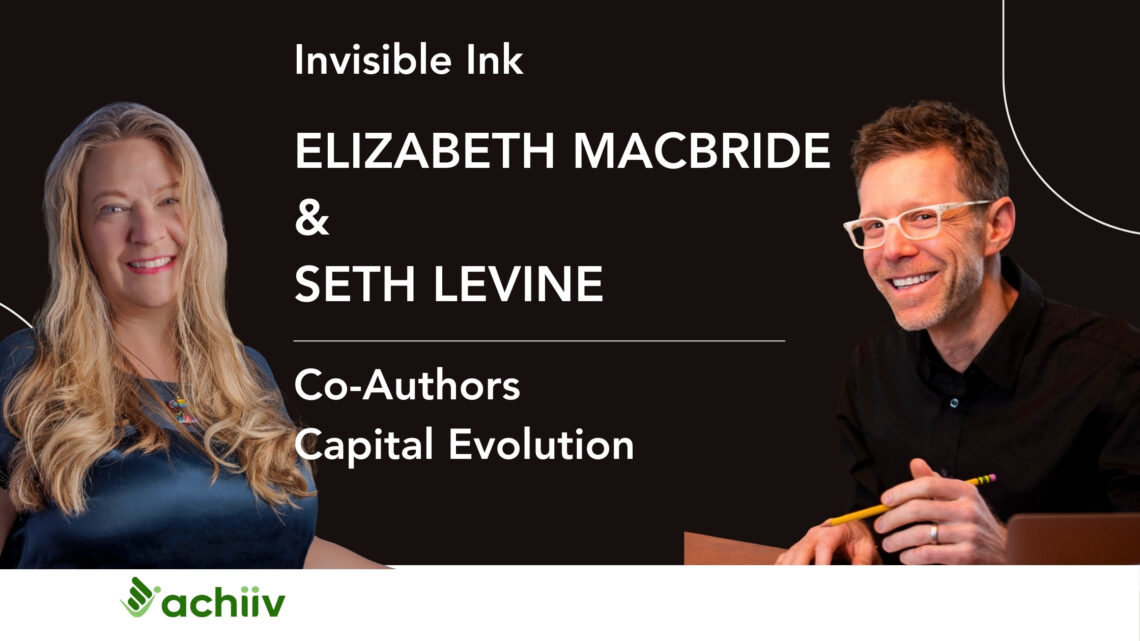
Press play to listen, or check it out on your favorite platform:
YouTube | Apple Podcasts | Spotify | Google Podcasts | iHeartRadio | Amazon Podcasts | Spreaker
About Seth Levine & Elizabeth MacBride
Elizabeth MacBride is a journalist, author, and entrepreneur whose reporting and commentary on finance, innovation, and global economic change have reached millions of readers worldwide. She is a senior knowledge and advocacy consultant with We-Fi and has also worked with World Bank teams on gender issues in countries across West Africa.
She is the co-author of three books, including The New Builders (Wiley, 2021), which reshaped how policymakers understand entrepreneurship in America and informed $250B in U.S. pandemic-era aid; The Little Book of Robo Investing (Wiley, 2024), and Capital Evolution (BenBella, Dec. 2025), which looks at the changing American economy through interviews with business leaders including the CEOs of JPMorgan, Verizon and BlackRock.
A longtime venture capitalist, Seth Levine works with venture funds and companies around the globe. His day job is as a partner at Foundry, a venture capital firm based in Boulder, CO, which he cofounded in 2006. Today, Foundry has nearly $4 billion in assets under management. A passionate advocate for entrepreneurship, Seth spends time as an advisor to entrepreneurs and policymakers—in the US as well as globally – especially in markets in the Middle East and Africa—to help promote entrepreneurship and economic development. He cofounded Pledge 1%, a global network of companies that have pledged equity, time, and product back to their local communities. He is a trustee of Macalester College, his alma mater. He is the co-author of The New Builders (2021) and Capital Evolution (2025).
Episode Highlights
- Why this moment in fundraising feels broken and why it is actually something else entirely
- The subtle signal investors are responding to now that most founders are not even naming
- How capital concentration quietly reshapes who gets funded and who never gets a second look
- Why ownership has become more than a compensation issue and what it reveals about long-term company strength
- What happens when founders keep playing by yesterday’s rules and why the game has already shifted
- The structural split inside venture capital that explains so many confusing investor reactions
- Why location has re-entered the funding conversation and how geography changes access in ways founders underestimate
- The real bottleneck facing AI and deep tech companies and why it has nothing to do with ideas
- Where truly patient capital is starting to show up and why most founders are still looking in the wrong places
- Why waiting for policy clarity is a losing strategy and what consistently outpaces regulation
- The overlooked way strong founders reduce risk before they ever raise a dollar
- Why persistence alone is not enough and when refusing to pivot becomes the real failure
- What credibility actually looks like in an AI-saturated world and why it cannot be automated
- The one mental shift that determines whether founders navigate this transition or get stuck in it
Links and resources
- Capital Evolution: The latest book by Elizabeth MacBride and Seth Levine
- Foundry Group — A VC firm with both a direct investment portfolio and a fund-of-funds founders can use to discover emerging managers.
- Armory Square Ventures — A VC firm advising founders to leverage industry experts for credibility, partnerships, and capital access.
- High Alpha — An Indianapolis-based venture studio funding and building startups within regional innovation ecosystems.
- Anthropic — An AI safety and research company supported by strategic corporate investors.
- BlackRock — One of the world’s largest asset managers influencing global capital allocation and ESG trends.
- Quantium — A quantum technology venture receiving major investment from the Qatar sovereign wealth ecosystem.
- Patagonia — A business rooted in environmental stewardship as its core identity and operating value.
- Hobby Lobby — A company built around a faith-driven operating ethos.
- Warby Parker — A mission-led consumer brand combining commercial growth with social impact.
- Business Roundtable — A CEO association that reframed corporate purpose to include stakeholder value beyond shareholders.
- Just Capital — A research organization identifying which social and workplace values matter most to American workers.
- Techstars — A global accelerator that invests in early startups and advocates for values-driven entrepreneurship, including as a B-Corp.
Interview Transcript
Shubha K. Chakravarthy: So Seth and Elizabeth welcome to Invisible Ink. Today I am pretty excited to get started.
Elizabeth MacBride: Thank you for having us. We are having to be here.
Seth Levine: Yeah great to be here.
Shubha K. Chakravarthy: So before we get started I know both of you come from very different backgrounds. So I am just going to start us off with I don’t know Elizabeth if you want to tell us your one superpower and then Seth if you can follow.
Elizabeth MacBride: That sounds great. It is a fun question. So I am a longtime business and financial journalist. My one great superpower is curiosity. It is led me into many places all over the world and I am never afraid to ask a question.
Shubha K. Chakravarthy: So you are going to be on the other side of that now. And Seth what would you say is your superpower?
Seth Levine: I am going to be curious to see whether Elizabeth agrees with this. We know each other quite well. So I am a longtime venture capitalist. I have been in the venture industry for 25 years. Started my own firm about almost 20 years ago now and Elizabeth has known me for a long time because we have written two books together.
We spent a lot of time together. I think my superpower is I tend to sort of advocate for my ideas very strongly and then like in a second if I really get pushed I will be like okay you are right, and I will be done. And so I think I can change my mind even when I am or be convinced to change my mind even when I am a pretty stubborn guy even when I have been holding onto something. I think I can do that pretty quickly.
Shubha K. Chakravarthy: Fabulous. Well it is going to be a fantastic conversation.
Seth Levine: Probably infuriating by the way to people on the other side of it because they are just arguing. And then two seconds later I am like “yeah, you are right.”
Elizabeth MacBride: No it is great. It is great because then I can feel like I win.
Shubha K. Chakravarthy: There is a positive to everything.
Seth Levine: Exactly you win all the time.
Elizabeth MacBride: Oh not true. That is completely not true.
Seth Levine: I knew that would get her going.
Shubha K. Chakravarthy: So congratulations on the release of your book. I had to read through it and it is pretty phenomenal. So just what is the short summary? What is the core thesis of the book and why did you feel the need to write it now? What are you hoping to accomplish with the book?
Elizabeth MacBride: Well first let me say it is Capital Evolution is the name but it is about dynamic capitalism. The thesis of the book is that we are in the midst of one of the periodic transitions that overtakes capitalism, especially, American capitalism. What some people have been seeing as the end of capitalism or the collapse of capitalism is actually just a periodic transition.
And we decided to write the book because three years ago when we started it we were both seeing signs of this shift underway but we had not yet identified what was happening. So we saw signs that things were changing and we wanted to figure that out for ourselves.
The Evolution of Capitalism
Shubha K. Chakravarthy: Awesome. Capitalism is at the heart of startups and getting startups funded and one of the arguments you make is that capitalism is not collapsing but it is evolving as you just mentioned.
So if you are a founder particularly in the thick of a battle for getting capital, what do you think are the clear signals that founders are seeing today or should expect to be seeing that this evolution is happening and maybe it is a revolution? I don’t know you convinced me through about it. What are those signs?
Seth Levine: Yeah well I think it is to be seen whether it is an evolution or a revolution. Let us hope it is an evolution because revolutions tend to be messy and sometimes dangerous so we do not necessarily want that. But I think specific to startups, like I actually do not think there is this thing that is specific to startups as we think about sort of the overall transformation of our economy.
I think it is true of startups and I am saying tech startups here right because of course most startups most brand new businesses are not technology businesses. They are called the main street or mainstream business which is really important right. And that was the subject of our last book together actually The New Builders.
But interestingly and this is often the case which is in part why our innovation economy works so well as is the case often there is ideas that are bubbling up from the innovation economy, the startup economy. So one of the things we talk about a lot in the book is not just sort of the concentration of wealth assets power et cetera but also the concentration of ownership.
Very few people actually own the majority of public stocks for example obviously if you own private assets, the government at the moment says that you need to be an accredited investor for the most part which means you need to already be pretty wealthy. And so all of this has resulted in this sort of like overall concentration of assets.
One of the things that startups have done really well is actually be more thoughtful about employee ownership. More thoughtful about leading with values, more thoughtful about other ways that they are affecting their communities suppliers et cetera.
And these are all aspects that we talk about of dynamic capitalism which is what we name the sort of next version of capitalism to in contrast with neoliberal capitalism or what you might call Friedman style capitalism which has governed for the last 50 or so years that there actually are these other aspects to operating a business especially if you take a long term view that are important. And so I think there is actually quite a bit that big businesses can learn from smaller businesses and startup businesses.
Values in Business: A New Paradigm
Shubha K. Chakravarthy: That is a great point that you make there. So it is clearly in terms of the output that is going out from the startup. I think the point you made is you are seeing more of the employee ownership, the stock option plans and all that stuff.
From an incoming side in terms of where the capital is coming in are there things that are either happening right now or that founders should expect to see happening in the next three to five years as they plan their build out of their firms?
Elizabeth MacBride: Yeah maybe I can take one pass at that and Seth can add to it because I feel like he has got a closer lens view on that question. Well first of all I think the clearest sign to me that something major was afoot was actually at the top of the economy.
And we wrote about it in the first chapter which was the Business Roundtable had adopted a new essentially a new definition of capitalism. It got sort of a bubble attention but then it was lost in the political divisiveness that rules are our current reality.
Seth Levine: COVID by the way hit four months later too. That did not help.
Elizabeth MacBride: Right and COVID hit four months later. Yes absolutely. They adopted it five years ago. They are still operating under this new definition of capitalism. And CEOs of those giant companies do have a lot of control over the world. So that is the clearest sign that things are shifting.
And I think in terms of the capital and founders and startup founders in particular raising capital what I have said I do not know if you will agree with me on this Seth because we have been asked this question in the past week or so. What I would be paying attention to is having to change your messaging. I feel like the old rules of capitalism were just money. Business model.
This is how you make money. This is your large market. This is what you are aiming at. This is the big idea. And then having a track record that or a team that could show you could fulfill that vision.
And now I believe investors are going to be taking that question of values more seriously because it will and is already becoming a differentiator because consumers have the power to pick the companies that are winners and investors also there are an increasing number of investors who actually do care about what your values are and whether you are meeting this current moment which is shifting toward a values driven economy.
Capitalism’s Future and Startup Strategies
Shubha K. Chakravarthy: I love that. So Seth I have a question for you on that. So you are like right at the center of the action. You are a venture capitalist and I know from having talked to you that you do care about values but you are also an observer in the larger VC system.
So do you actually see this happening outside of like the pockets of impact oriented investments just in the what I will call the mainstream startup investment community.
Seth Levine: So one of the things I think we should clarify is what we are not suggesting in dynamic capitalism is that every company should be an activist company. Like that does not work. And in fact we very clearly say we do not think that is what should happen.
And in part what led us to write the book was some questions around where that line is and should companies take stances on certain issues right. I think we spent a lot of time both debating Elizabeth and myself debating but also with some of the people we interviewed in particular with Jamie Dimon who is the CEO of of JP Morgan Chase.
He was also the chair of the Business Roundtable when they came out with that new proclamation on the role of businesses in society. And we pushed him a lot on this because he was sort of arguing for a values driven orientation not a politics driven orientation.
And we really pushed him on where is the line because division in politics stem from values and maybe that is getting blurrier now because there is a set of values around affordability and things like. But I want to clarify that because I think it is important. Because oftentimes when you hear about the future of capitalism and it was certainly we read a bunch of other books on this subject sort of in preparation for writing this and one of our critiques was that the vast majority fell into two categories.
One was sort of an academic treatise, usually written by someone at a business school or a university, pretty unpractical, written by people that did not have a lot of direct experience in business. And then the other was a personal journey story, a CEO of some company that whatever had been successful and they had some values orientation they want to share that with the rest of us. Interesting but not necessarily extensible to other companies.
Elizabeth and I really felt like we bring kind of a different perspective as practitioners, as people who have been in business for 30 years writing about business, observing business, investing in my case in businesses, working for businesses et cetera. That was a different orientation. And so the book is very pragmatic and I want to be careful as we sort of set up the broad arc of what we are talking about that this is not some pie in the sky, like what if we just all held hands and got along that it somehow would be better. Like we are both capitalists.
The book is a defense of capitalism not of the capitalism we have been practicing necessarily but a recognition that capitalism is still sort of in the Winston Churchill way of saying it. It certainly is not perfect but it is the best of everything else we have got. And it feels even more important to be having this conversation now because as we are recording this, New York just elected a socialist mayor. But at the same time there are 11 companies worth more than a trillion dollars.
Nvidia recently, it has backed off in the last few days, but was worth more than $5 trillion. It is bigger than the entire economy of Germany. So these things are happening at the same time. Elon Musk has a potential trillion dollar pay package. So these things are all happening at the same time. And to us they are signs that we need to have a real discussion about what is going on in our economy and how people participate in our economy.
We often say that populism on the right and the left are driven by the same thing. People feeling like they were unconnected from the market system. Their ideas for what we should do are wildly different. And you can read the book and kind of figure out we do not talk about. Mamdani showed up after we wrote the book but you can imagine what we would say about that. But it is important to understand where does this come from. And then of course how can we do better. And we have some thoughts on that.
Shubha K. Chakravarthy: Awesome. So I just want to kind of close out the conversation on values. People have a certain association perhaps on values. Can you give us some good examples from either real life or some of the companies you have seen of what might be not traditionally thought of as a value but still operates as a good value to guide a startup or any kind of new venture or growing venture?
Elizabeth MacBride: Yeah, so there is a lot of examples in the book and some research as well available from a group called Just Capital, which actually surveyed tons of people across America and came up with what people really want in terms of a value from their company is first of all that they treat their employees well. That is not you do not hear talking about that so much in the impact space, which is a sign that maybe the impact space also needs to evolve.
But treating your employees well, it was the number one value that Americans want companies to do. And let us face it. Companies have a long way to go on that journey. There are many companies that do not pay their people well or do not treat them well in terms of labor conditions. So that is one. And we also gave examples of a lot of other companies one traditional sort of impact darling would be Patagonia.
So environmentalism broadly, that is a value that a company can build itself around. We also give the example of Hobby Lobby, which really built its value system around the idea of the faith of its founders, and that has led them and attracted a loyal client base and also probably employees who largely agree with that set of values.
So we are not saying, as Seth said, it is not holding hands and Pollyanna and Kumbaya. It is more like in this environment, a startup founder really needs to know who they are, what they stand for. And I would say from the beginning, they need to know that, in this environment, because it is going to help determine who your customers are, who your investors are, it is going to narrow down the work you need to do to find the funding.
Seth Levine: One of the things that this makes me think about, if I could just interject, is the first question I ask every company that pitches me for investment in my day job as a venture capitalist is to give me their backstory. Tell me how you arrived at this idea.
And it is not explicitly a values question. And Foundry is not a values oriented investment firm in the sense that our investors simply want us to return more money than they gave us. We are only measured on that. We are not measured on any other sort of impact measurements, and so they somewhere between tolerate and embrace that we, for example, became a B certified financial services firm.
We were one of the first sort of, certainly the first really large venture fund to do that, followed by Techstars and a few others, but that cannot come in the way ultimately of our making more money now. We argue back to them that having this values orientation allows us to both win more deals but also find founders that are more likely to be successful.
Which is why, back to the question that I ask, why I ask every company that comes to pitch me that question, because I am searching for that thing that drives them, right. And when things are hard and not working, what is it that is going to get them popping out of bed in the morning, ready to go knock down walls again, even if yesterday they ran into a bunch of walls and it seemed futile. There is a values concept behind that I think is really important.
Sometimes it is explicit around other things and there are venture backed companies, Warby Parker comes to mind or Etsy or others that are like very clearly, hey, we are giving a pair of glasses away for everyone we sell or we are trying to empower this group, and we think that is also a good business idea.
And then there are others that are much more subtle, which are like, hey, we come from a marketing background and I cannot believe this thing does not exist, why cannot you do this and this with your data from this system and we have got to fix that. And there is a sort of a funny values orientation inside of that as well.
Shubha K. Chakravarthy: That is interesting. Never thought about marketing data and values in the same sentence, but now I will. So the thing that becomes very clear to me is a couple of things. There is a macro level conventional understanding that you can pick from this. But to me, the more interesting thing is Seth what you mentioned, which is it is a differentiator.
It is a driver, a motor, an accelerator for progress which also sets up very clearly who they will attract and who they will not attract. So in that sense, it is a differentiator. Like it is clearly a motivator and a differentiator. I had not thought of it that way.
And that is super interesting. Thanks for that. You talked earlier about capital concentration. It is very clear that capital is getting more and more concentrated. It is consolidating right at the top. And yet if we are to say America has always been known as an innovation economy, we have been at the forefront of innovation.
And at the heart of innovation is experimentation and the core of experimentation is error and failure. So how does that show up and what are the practical implications for founders when they are pursuing this capital that is highly consolidated, and yet they have to face, to your point Seth, run into walls every single day in the process of experimenting, what is that tension and how is that how is that showing up in impact on innovation?
Navigating the Innovation Economy
Elizabeth MacBride: Oh, it is so serious. I think you have to understand this from the macro level because Seth and I think are both very concerned about the way the innovation economy broadly is evolving as we are in this kind of like transitional moment because there are troubling signs that the innovation economy in the US is heading for a downturn.
Because of the concentration of capital, because the federal government has pulled back on some of the research funding, because it was as well like a huge funder of deep science and deep tech and that is what really drives the big innovations.
And then at the same time you have got other countries. Okay, China, that are experimenting with developing their own systems of innovation. We are both like Jamie Dimon, right, red blooded American Patriots, I think. Part of our motivation for writing the book and speaking out so much about it is that we do believe that America still has the edge on innovation, but we need to recognize that it could be slipping.
Shubha K. Chakravarthy: What is the answer?
Seth Levine: Well, more broad. We just want to frame it for a second for listeners, because more broadly in the economy what we would call economic dynamism, which is a dynamic economy that is resilient and where people have opportunity to both move jobs, move locations but also move up their station in life, like that has been decreasing significantly in the United States.
Which is why we, Elizabeth and I along with Congressman Ro Khanna, wrote an op ed in the LA Times about sort of investing in our innovation economy. It is why we care so much about this topic. We cannot take it for granted. I think part of our argument in the book is we do not take this for granted. Like we actually need to do things to maintain that economic edge.
The US continues to be the place where people want to come to start their businesses. We have a society, generally speaking, that is very open to that. We are open to failure, which is a big differentiator between us and many other countries. And we continue to have the best sort of innovation funding ecosystem despite all of its flaws. And so I would like to see us of course get better about that. Fund more and diverse types of founders who have different ideas, right. There is lots of research that suggests that there are many great ideas out there.
What do they say, opportunity is not evenly distributed but talent is. So we we should do a better job in our innovation economy of finding those incredible innovators that maybe do not come from directly from our networks. That is probably a topic for an entire podcast. Something I have thought about a lot. I think I have mostly failed at, frankly, although I have tried to work in and around for a long, basically since I have been in venture.
But these are all things that I think are important for us to lean into as we think about how do we maintain our competitive and economic edge. And that is what we are arguing for in the book. We believe that the US should continue to be the country that leads the world in economic innovation.
There is a reason that the biggest companies in the world are all, biggest technology companies for sure are all from the United States. The mag seven is a distinctly American phenomenon. But we cannot take it for granted. We have to fight to keep it. And that is what the book is really about. Some practical ideas and some maybe some unpractical ideas for how we make sure we maintain that.
Shubha K. Chakravarthy: Got it. So is there like one takeaway in terms of a founder who needs to indulge in or engage in that experimentation but faces let us call it consensus capital, and still has this wall? Do you have one takeaway that they could use tomorrow, Monday?
The Role of Geography in Startup Success
Elizabeth MacBride: I would be careful, I would be very interested in which state and geography within the United States to locate my very innovative startup. That is my takeaway in the current moment. I do not know what you think.
Seth Levine: Well, I would also say that too many people are trying to play exactly the game as it is defined right now, and the rules are skewed. And so I think one of the solutions is to not play the game that way. There is a bunch of ways to do that. One is to stand up your business and go find customers first. Another is some different forms of capital.
I think this is kind of what is behind Elizabeth’s comment about what state you started in matters. There is a lot of both place based capital out there but there is also quite a bit of state level fund things like that where you can actually get paid to go move your business somewhere. And then that may be a dissatisfying answer because we also need to work to change the rules of the game, so people have better access.
And I experienced this myself. I am a startup founder as well. And I have gone through the process of trying to get people to respond and it is infuriating, but you also have to stay at it. And the number of companies that Foundry, for example, is funded, where we were the 37th or 370th firm that someone reached out to but it ended up being incredibly successful. Sometimes you just have to keep going at it.
That is and I think that there is some truth in that. And I think one of the things that is maybe frustrating about sort of the valley culture, the Silicon Valley culture, is that there are some companies that just it is so easy and you kind of fit the archetype and people are lining up to give you checks. And it is incredibly frustrating.
There are a lot of people in the world right now who are trying to fix that and who are interested in talking to founders that do not look like that, but they are not high profile, flashy. They tend to be somewhat smaller, somewhat newer funds. And so it takes a little bit more work to find them.
Shubha K. Chakravarthy: So I am all ears on both of those. So Seth, tell me where can I find them. Who are these people.
Seth Levine: Ha, well, you could we have Foundry has funded a lot of them, right. So we have a funds portfolio as well as a direct venture portfolio. So you could start there. If you just go look at the funds on our website, but that is 50 funds. There is 500 of these funds. And so it is going to take some research.
But you have got AI tools now to help you do that and you have got more traditional search tools. But if you are looking for a place to start, you can start on our website, but I would expand that. There are literally are hundreds of firms that have been stood up in the last three to five years that are really trying to actively change the paradigm. And so it just takes a little bit of effort to find em.
Shubha K. Chakravarthy: Fabulous. And Elizabeth, any additional light on the state comment that is very intriguing.
Elizabeth MacBride: Well, I do think there is place based capital, but I think I mean my observation from reporting all over the US is that there are some places that first of all are more supportive of deep tech and more deeply innovative companies. They tend to be around universities, I think capital clusters in those places that is there to build those kinds of companies.
Like geography is something that founders, especially those who come from the two coasts, do not recognize as a big driver. There is a lot of capital in the world that is predicated on the idea of we want the next big thing to be from our city. And so High Alpha in Indianapolis is a good example of that. It was a big company acquired by Salesforce.
Seth Levine: It was Scott Dorsey.
Elizabeth MacBride: Yeah, exact.
Seth Levine: Find them on our portfolio page.
Shubha K. Chakravarthy: All right.
Elizabeth MacBride: Yeah. And Bentonville Arkansas is another place like that, Minneapolis, there will end up being a big successful company that is acquired or goes public from a second tier market. And then out of that one of the founders will become themselves the center of a new venture ecosystem and they will start funding startups.
The Impact of Capital Consolidation
Shubha K. Chakravarthy: That is fabulous. Those are two very good actionable items, so thanks for that. One other thing is you are starting to see with this consolidation of capital, it is all these huge asset managers like BlackRock and others, and definitely it has a downhill effect.
They are controlling capital right at the top, they are the ones who are determining asset allocation into various classes including venture capital and all of this stuff. How is that going to impact startups’ access to capital, and in particular, I am going to ask you about this latest thing I am seeing on LinkedIn in terms of consensus capital and non consensus capital and how there has been this stratification or this bar effect of you are seeing the consensus firms at the top just investing in a certain class of startups and then leaving a whole bunch of other startups out in the cold? I am just curious about what your thoughts are on that and what the actionable implications are for founders.
Seth Levine: I think that the venture capital world and I have been in venture for 25 years. It expands and contracts and expands. It is just like constantly that is what happens. And it just it seems very prone to these to bubble like behavior, which I have now decided is probably a feature, not a bug, of how we fund startups and how sort of venture works.
And so we are going to experience a contraction. The expansions happen quickly and the contractions happen slowly in the venture market. It is just how it is. It takes a long time. When there is money all over the place like during ZIRP in 2021, it was easy easier for people to start their firms.
And so there was all this money rushing into the sector, and then it takes forever for those firms, if they are not going to be successful and not raise more funds, they are just sort of still out there forever kind of hanging on. And so that is just part of how it works. So I think we should just recognize that.
I do not think actually that the big asset managers, BlackRock and others, are controlling the speed at which either the expansion or the contraction happens. Now there is a separate issue, let us put a pin in that, about the consolidation of particularly public market resources with the four big asset managers, 80 percent of all investments in public markets are through one of four entities. So they have a ton of control.
They own a meaningful portion of every company in the world or every company in the US, like that is listed. And so that is a separate thing. But specific to venture, this trend that you are talking about is actually something I wrote about years ago, which is the like the barbell of venture, where you have these like really big firms that are essentially asset managers.
They are clipping a coupon, which is the management fee. They have massive funds, they have got tons of partner, they have all these services and they have to make relatively large bets because when you are investing out of a big fund, that is kind of what you do. But you have a really big fund.
If you make two and a half times that fund, there is a ton of carry there is if you can do it fast enough, the IRR is good. So that is one type of firm. And then on the other one, you described them as non consensus, but you have sort of more of the kind of alpha seeking firms as opposed to beta plus, let us say, which tend to be smaller.
Shubha K. Chakravarthy: Yeah, I love that.
Seth Levine: So they tend to be, in the current market environment, they tend to be caught $150 million or smaller. And those are sort of much more craft firms that are trying to, not craft ventures, craft firms, that are trying to sort of continue with this style of venture that used to be what everything in venture was.
And there is not one that is right or wrong, but it is just important to note kind of the difference. And if you are in the middle, it can be a little bit challenging. I mean, I think Foundry is sort of bumping up on the upper edge of this bottom thing.
You have to kind of strip out our fund to funds practice and sort of we are more in that kind of smaller range, but a couple hundred million dollars dedicated to that per fund. And but much bigger than that, you are sort of in no man is land. But it is important to recognize that is really what is, it is been happening for a while and it continues to happen.
Shubha K. Chakravarthy: So Elizabeth, do you have anything to add, and then I would love to ask you about the practical implications.
Elizabeth MacBride: Yeah, I do think there is one thing we have not talked about, and Seth and I have not talked about it, actually. There is another kind of concentration of capital going on, which is that because of the way the wealth is skewing in the US to individual families, there is also, I think, family offices that do to some extent as limited partners in all kinds of different funds, venture capital funds or private equity funds or different, whatever roles they play.
And honestly, to get any good reporting on how that system is evolving is very different, very challenging to do as a journalist. So we do not really know what is happening in that world, but I do think that they are setting some of the agenda in terms of the innovation that is happening. And so it is just something to be aware of, and I would love for somebody to take that up as an issue and to try and get more accountability into that system of family offices.
Shubha K. Chakravarthy: Love that. So one last thing on that, and I want to talk about energy transition. So any last words on like where the next generation of genuinely experimental, patient, long-horizon capital can come from, especially as you are seeing more and more safe bets in the VC world? If I can be provocative, right? So who is going to fund the truly risky stuff?
Elizabeth MacBride: Saudi Arabia, sorry, maybe.
Seth Levine: I mean, it is interesting if you look at, for example, the announcements in quantum coming out of the Middle East. Qatar just put a bunch of money into a joint venture with Quantium. And it is interesting to see where risk capital is shifting.
And so, yeah, no, I think that is absolutely true. Israel, Saudi, UAE, Qatar, like, they are making increasingly risky bets. And I think if I was advising, whatever, the US government, and talking about like, why is this important, I would just point to that and say, is that where we want all of this money to go to, right?
And I think one of the things that I actually give Trump some credit for is that I mean, five, six years ago, AI was not happening in the US. There was such an anti-AI and, frankly, anti-crypto sentiment. I think it was absolutely to our detriment, and I am glad to see those policies reversed.
There is a lot of nuance to what needs to go around that; it is probably more than we want to get into, but broad brush strokes: is it better to have Tether, which is a USD stable coin? Is it better to have them operating in the open, wanting to be registered in the US, again, skipping some of the nuances of the agreement that was made with them—a hundred percent, it is better.
We do not want companies like that operating in the shadows of the world and of the internet. And so I think that we need to be open to and embracing new technology, even if it is scary, as in the case of AI, and maybe scary to some in the case of quantum. But those companies or those technologies will get funded.
They will progress, and they will progress elsewhere if we do not let them progress here. So that is the overarching view. Again, there is a much more nuanced view of, okay, what does that exactly look at, like, how do we do that in a way that is respectful of privacy? And there is all sorts of things around that.
Although, actually, I kind of think the market is in the process of helping figure that stuff out and I think we are sort of in that messy beginning when new technologies show up and we do not really know what to do with them.
And we have got people walking with flags in front of automobiles in 1910 because they are so scary and, oh my gosh, there are these cars! And so there has to be someone, there has got to be a flagger. So we are in that phase right now of some of these new technologies, and we will get past that, and we will figure out sort of what the right rules are.
Shubha K. Chakravarthy: And if you were the advisor to one of these startups, what would you say? You said if you were the advisor of the government, but I am asking if you are an advisor to a startup.
Seth Levine: Well, well, I would go to wherever the money is, right? If as a startup, like, you want to get going, you want to get going in the place where there is money and there is the fewest unreasonable restrictions. So let us at least put that caveat on it.
And so I would be encouraging companies where that exists. I believe that is mostly still in the US, but I have some concerns that it will not continue to be that way if the rhetoric ends up winning out, if fear wins out. I think that actually what will happen is it will be incredibly disruptive to the US economy, and we will not reap any of the benefits from it. And I think that is a terrible combination.
Shubha K. Chakravarthy: Thank you, Elizabeth. You were going to say.
Deep Tech and National Security
Elizabeth MacBride: I was just going to add to this because I think there are a lot of founders in these deep tech spaces, cryptocurrency, cybersecurity, quantum. I am speaking more from the public responsibility and the idea of evolving jointly our system of economics and society, which is what we write about in Capital Evolution there.
If you are one of those founders, I think you need to be participating in this conversation because you are innovating in your space, you are seeking money, you are doing all the things that Seth just described. But these spaces are so powerful, and they are so important to national security and to the future of our country and economy.
You are not just building an e-commerce site anymore, like we were 20 years ago. For instance, you take the biggest heist in global history happened in February on a cryptocurrency platform that had no home. It was based nowhere. So it had no regulations. I forget how much it was, $1.5 billion, $2.5 billion in cryptocurrency stolen off that platform by North Korea, by hackers aligned with North Korea.
And what did they do with that money? Now they are laundering it through the system because the US had not yet acted to pass regulation to make this stuff secure and transparent. And so North Korea slipped in there, and the national security people I talked to believe that now North Korea is going to launder that money and use it to buy a new missile.
So these issues are not just in your small startup space, right? They are very serious. And I do think you should put some time and conscience into where you are locating your business and evolving a system that has rules that can work.
Energy and Climate: A Capital Allocation Challenge
Shubha K. Chakravarthy: This is awesome. This is good stuff but serious stuff. There is one other sector in deep tech that we have not talked about, which is energy and climate.
So, there was a lot of activity, and there still is in terms of the startup space. And one thing I noticed in your book was that you talk about it as a capital allocation challenge versus maybe some other frames that have been given to it.
And clearly the environment has shifted pretty dramatically, I would say, in the last 12 to 24 months in terms of where there was funding, where there was opportunity versus where it is today. So what is the outlook, what is the prognosis, and what is the counsel for founders who are operating capital-intensive startups in this space?
Elizabeth MacBride: Yeah, I think you had really good questions on this, and it is one of the places where there is a sharp difference between kind of the government’s current rhetoric and the realities of the market.
And Larry Fink is the best example in our book about this. He went out hard five years ago, saying we are going to invest in technologies that protect the environment because this is where we are going. We have got to move away from fossil fuels. We need more energy.
And then he got totally slammed for it, right? “Woke capitalism.” ESG is a dirty word, and he retreated from it publicly. But when I asked him about it at the Aspen Ideas Festival, he made it clear: they are still doing the investing. He is just not talking about it as much, and there is not as much government support for it.
So it is an example, just to your questions, of where the reality is not as aligned as it used to be with the rhetoric coming out of the government. But in terms of like how you practically play that bifurcated reality as a founder, that I do not know. Maybe, Seth, you have some thoughts about that.
Seth Levine: Well, I do, but I want to frame it in the sort of the larger context because I think one of the things that we talk about in the book, which is really important to understand, is the US won the 20th-century economy because we were the best and most efficient energy producer in the world. Right now, in the case of the 20th century, those were mostly extractive forms of energy, but it is absolutely true: this is what won the century for us.
And we believe that what will win the 21st century will also be energy, right? And we are seeing an example of it, which is AI, and how much power that is, that is requiring. And we are not doing what we need to do as a country to win this next century in terms of energy. And so our belief is certainly to lean into alternative forms of energy because at a practical level, fossil fuels are going to run out. And it is becoming increasingly challenging and in many cases to extract them from the ground. But we also argue for sort of a pragmatic shift.
This idea that we can stop pulling fossil fuels out of the ground in 2030 or something like that and just shift completely to alternative forms of energy is just not at all realistic. And so we need to be doing both as we transition to a new energy economy. There can and should be a lot of opportunities in the new energy economy.
That is not just how do we build more efficient power plants, although it could also be how do we invest more in nuclear. China has 35 nuclear power plants that are in process in production right now. We have, I think, zero or one, right? So it is, and that might even count the Three Mile Allen thing that they have renamed. I cannot remember the the name.
Elizabeth MacBride: I know. I thought that was so funny that I was like, is that Three Mile Island?
Seth Levine: Yeah. No, it is something like “Clovis Clean” or something. It is some funny name. And I mean, I am not saying we should not count that in the sense that yes, that is true but that is relatively old technology that is being spun back up. We are, that is like Gen One in nuclear technology.
We are on Gen Four right now. And so, and which is, by the way, it is super safe. And just to pick on one thing, but there is also thoughts around distributed energy production, thoughts around battery, and how we do battery backup, both for individuals as well as for industrial use.
And we would be spending more time, energy, and money in that, from perspective as a country, both publicly and privately, if we were being more thoughtful and smarter about how to win the next century’s energy war. And by the way, that will also include streamlining permitting so you can get these things built faster.
And I mean, the amount of power that is required at an AI data center is absolutely massive. So we are going to struggle to keep up if we cannot lessen the burden on exploring new power sources and, and building new power capacity.
Investment Strategies in the Energy Sector
Shubha K. Chakravarthy: So, if I had to paraphrase what you just said, Seth, is it accurate to say that there are two main takeaways I picked up from that? Number one is do not look at climate or energy as a monolith in terms of a market or investment area. There is clearly those subsectors, and you have to be thoughtful about which subsector you are going after and how urgent or compelling that market is so that you make that choice thoughtfully, to the extent that you can, clearly you are specializing in a certain technology.
And the second big takeaway for me was follow the money, right? Where the money is, where there is demand, and you can choose to satisfy the demand in a more energy-intelligent manner using some of these technologies so that you are kind of once again helping the US and, frankly, helping these companies do their job in a more energy-efficient manner. Would that be a fair characterization of what you just said?
Seth Levine: I think that is exactly right. I think, yes. I think we tend to think of energy and energy policy as this like, one overarching thing, but it is actually a lot of both little and big things, but a lot of things, right? And I think that is the right way to think about it, both from an investment perspective and from a sort of public policy perspective.
I think again, just to reiterate, like Elizabeth and I in the book are really pragmatic about this idea that climate is a real challenge. To the story around Larry Fink. And as he said very famously, “Climate risk is investment risk.” So we believe that, we know the government believes that.
I mean, one of the, one of the sort of biggest planners, if you will, around, around climate change is the US Navy. They spend a lot of time, energy, and money trying to figure that out because, of course, so much of their asset base is sitting in low-lying areas because it is literally on the ocean. But they have the bases and all the things that are surrounding that, right?
So that stuff is happening and it is okay to talk about it. And I sort of want to get away from the debates about how much can or humans, contributing or whatever. I was on another podcast and he really wanted to engage in that debate, and I was like, look, it does not matter. It does not matter.
Like, we still need more power, and we are not going to get it by burning dead dinosaurs, right? We are going to have to find other forms of power. So let us talk about how we do that in as efficient and effective a manner as we can and at that scale.
Elizabeth MacBride: Yeah, and I would just add to this that this is an area where the government rhetoric is so aligned with the fossil fuel companies because they have a big stranglehold on our public conversation, right? You cannot look at the past 100-150 years of American history and not realize how entwined fossil fuels are in our economy, in our public spheres.
And some of this divisiveness that we are seeing now is a result of the rest of the world recognizing we need to pull away, we need to find a new path beyond fossil fuels. It does not have to be sharp, it does not have to be sudden, like, it is a transition. We are going to work on it together. But to think that we can continue on the path we are on is crazy.
The rhetoric coming out of the government and that is not a political issue. Kamala Harris and Donald Trump were the same on the stage about that question, right? “Drill, baby, drill.” And we need fossil fuels. They have always said versions of the same thing. This is a space where the government is not going to have the answer. The market has to create the answer, and the markets are clearly moving toward different forms of energy.
Funding and Innovation in Deep Tech
Shubha K. Chakravarthy: So that brings up an interesting question, right? Like, on the one hand, you mentioned fossil fuels, and both personally from experience, as well as from your book, we know that many of these large companies are seeding alternative fuel or future energy technologies for pragmatic reasons, number one.
And then number two, to your point, there is potentially a dichotomy or at least a bifurcation between what the policy and the current funding flows are into the space versus what is perhaps happening in the private sphere and what industries buying to your point about AI energy centers.
I am trying to come back to the founder who is in this space and who is dealing with this reality day-to-day. What are the opportunities that they perhaps might not be looking at? And what are some smart, pragmatic actions they can take to increase their chances of getting capital and being successful?
Elizabeth MacBride: Well, look at European funders for one thing. And there, I feel like there are a bunch of them who are actually looking for opportunities in the US because I was talking to some energy think tank guys and some deep tech funders from Europe, and I think that they are looking for startups to fund in the US in this space.
Shubha K. Chakravarthy: I will get the list from you after the podcast.
Seth Levine: There you go. I mean, look, we are not, we do not fund energy, I am a little bit sort of out; I am an observer, not a participant in these sorts of markets. And so I continue to believe that there are, and I have seen this directly, really interesting innovative technology upgrades coming from CalTech, Stanford, MIT, other places.
I hope investors are open to leaning into those things. And there is a huge buyer universe right now because more so than GPUs, the limit at the moment to increasing data center capacity in and around AI in particular is power. So there are built-in buyers for these things. And so there are built-in partners if you have new energy ideas, new ways of extracting, new ways of being more efficient with energy and energy consumption.
And by the way, 30% of the cost of the energy portion of any data center is just planning for essentially peak load, meaning peak load outside of the data center. So you have got to overbuild by 30%. And so if there are just pointing that out as an example of a place where if you could help address those issues or better plan for those or other otherwise sort of participate in that, that would be an example of you do not even necessarily need to be the one producing the energy, but if you come up with a new data controller that allows you to smooth those things out as an example, that would be hugely beneficial.
Because the cost of a data center for AI is billion-plus dollars, maybe billions of dollars. The power portion of that is maybe a couple hundred million of it, but it is still pretty big. So there are definitely interesting and innovative funding avenues out there for companies if they look for the right partners.
Shubha K. Chakravarthy: So in my simple mind, I will call that follow the Money 2.0, which is the advanced graduate-level course, if you will. I want to come back to one thing you said. You mentioned these universities and the fact that there is all this research happening. But I mean, let us face it, a lot of the research was funded by the government, is funded by the government, was funded by the government.
And that, I do not think anybody can say with certainty, that is going to continue to be the case in the future. So what does it mean in terms of other options for sourcing innovation, for lack of a better word, for those of our founders who are hungry to tap into these technologies but can no longer perhaps access some of these grants? Some are still available, many are not. What are your thoughts on that?
Elizabeth MacBride: Such a tough question, but it is one I think the whole world is going to have to grapple with, because it is not just the US government that is shifting and pulling back from some of these investments. Governments in general are sort of are low on money at the moment, and probably for the next few decades, for a host of reasons.
We are going to have to see big philanthropies stepping in bigger ways. And you have already seen the Gates Foundation do that in the health space, more on the ground like funding current programs, not so much in research, but it kind of goes to the point that brought up earlier about these huge concentrations of wealth in families.
And they have historically founded big foundations that lasted for generations. And I wonder, if I were sitting in a room with some of those people, I would say, okay, maybe that is not the best approach right now. Maybe this is the moment to say, I have got this big pool of money and I am going to spend it over the next 20 years on this particular innovation. Maybe that is one source potentially.
Shubha K. Chakravarthy: Interesting. Seth, did you have any other thoughts?
Seth Levine: I think those are all great ideas. As government continues to step back, now I hope that there is an ebb and flow to that, and I hope that at some point we will recognize that is probably not in the interest of the US, and we do have a sort of economic and potentially military adversary in China that is investing very heavily with state money in sort of foundational research.
And that has done very well for the US in its history. So do we abandon that at our peril. But I do think that there are other sources of that. I would also say that there are really large companies. I mean, one of the benefits I suppose of the incredible profitability profile of many of our largest businesses in the US is that they have room to experiment with a bunch of different things. I mean, think about just Microsoft is investment in OpenAI, a billion dollars in 2019, back before any of us understood what that was and had any ever even heard of Chat GPT. I mean, that helped them kind of get off the ground.
Obviously Google has all sorts of projects going from Waymo in self driving, which was sort of this skunk works idea, to flying taxis, to all sorts of other things. Many we probably do not even hear about, a ton of them that just end up not working out. And it is no accident that there is a lot of quantum research being done at Google, right, in their Willow project, and IBM, and sort of other large companies.
So do I think it is the best thing for the US innovation economy to only have science based research being done, 10-20 year lifecycle research being done at adjusted companies? Probably not, but I am glad that at least some of that is happening, and hopefully to Elizabeth’s point, some foundations, family offices, et cetera, will step in.
Shubha K. Chakravarthy: So the practical implication then for somebody who wants to pursue an idea in this area is to maybe work for one of those companies. I can certainly see that, but we are still talking about the traditional path, which is, hey, go find something new, get the research funded, and then try to commercialize it.
I guess I am trying to probe for other ways of maybe thinking out of the box, for lack of a better word. Are there other sources of innovation that maybe do not require those?
Seth Levine: They look at the effect of AI, on all of this. And I think there is a real potential and we saw announcement relatively recently from the Trump administration. I am trying to remember what they called it, but it was Project Mosaic or something like that, where they are going to really try to lean into, how do we become much more efficient in our research by leveraging AI tools.
So absolutely that should happen. Like the amount of time, energy, and money that goes into bio technical research that could be potentially circumvented by AI and AI modeling, I think is massive. So I certainly, if I was sitting at a large foundation and I was worried about whatever drug discovery or something like that, like I would absolutely be leaning into brand new ideas around this.
And I am sure there will be a lot of entrepreneurs that also come to the table and say, hey, how do we streamline some of these innovative processes so that we increases our chances, increase our chances of success and shorten the time it takes to do the research.
Shubha K. Chakravarthy: Got it. And one.
Elizabeth MacBride: And I would just add one other practical idea, because I picked this up from a venture capital firm, Armory Square Ventures, in upstate New York, who talked about if you are a startup founder, and most of those are going to be located around a university where there is a core of people working on that particular problem.
One of the partners at Armory Square said they advise their deep tech founders or the ones in their network to bring on advisors from big companies because that is going to be a conduit for pulling down money from the company or for partnerships or ways to test markets without necessarily getting constrained or having your innovative ideas killed by the environment of the big company.
Shubha K. Chakravarthy: I love it.
Seth Levine: And by the those big companies might also be good investors in that. We talked about Microsoft and OpenAI, and by the way, OpenAI is not captive to Microsoft. And Microsoft is not captive to OpenAI. They have made some big announcements about working with Anthropic as well recently. So, but those are not bad avenues for some of this deep tech research to maybe get funding.
Shubha K. Chakravarthy: Great. So which leads me to my last question on this topic, which is we have talked about a bunch of different actors. We have talked about a bunch of different sources, and there are others too. We have not really talked much about corporate innovation.
I mean, we have talked about some corporate innovation groups, but we have not talked about sovereign wealth funds. We have not talked about private equity, we have not talked about regional governments. Are there other maybe strong bets that you would care to make in terms of who would be right and suitable to step up to fund a innovation?
Seth Levine: Yeah, well, we have definitely referenced sovereign wealth because the references to UAE, Saudi and Qatar are all essentially references to their sovereign wealth fund. So I think that there are, the world is becoming more interconnected, and because of that there are more players that think about and care about funding these innovative ecosystems, and they want them there.
I mean, there is an entire section of Dubai that is a sort of a special tax zone that is designed to attract companies. PE players, PE firms tend not to be investors in the innovation economy. They tend to play kind of a different role in finance.
I do not necessarily see that changing. They are just not set up to take the kind of risks that are required. But as Elizabeth already pointed out, there are family offices, individuals, others, maybe some communities, although I do not think sort of government, venture style funds are particularly effective at investing in this sort of stuff.
I think government grants to universities are effective ways of investing in deep tech. And again, that seems to have been sort of ebbing and not flowing at the moment, but I do not think that government like style venture funds are typically particularly helpful. But certainly there are government sort of public private partnerships in particular, and we point some of them out in the book that can be very effective for helping spur innovation ecosystems.
We saw that around biotech and med tech in Pittsburgh. You see it around transportation technology and entrepreneurship more broadly in in Detroit. So there there are a bunch of examples where government partners with private sector to maybe spur an economy around a certain type of technology in a certain area.
Shubha K. Chakravarthy: Got it. And private equity and I take your point, although I have been hearing lately that they have kind of stepped up closer to the backend of early stage investing in terms of rolling up some of these firms.
So they are releasing some liquidity into the system, which then you can argue can flow back into early stage venture, but your points are well taken. So there is all these little pockets of opportunity. They are very fragmented. You need to understand that Pittsburgh did the following things in terms of computer investments 40 years ago, whatever the case might be.
Or some of these other Detroit and all of these things. I am a deep tech founder. I am already like in over my head. What counsel would you give to just max my chances to getting at these sources of capital?
Elizabeth MacBride: I mean, send a lot of emails. Really it is what Seth said before. It is hundreds and hundreds of use.
Shubha K. Chakravarthy: And use AI to get smart.
Elizabeth MacBride: Use that.
Seth Levine: AI to customize it. So look there is no shortcuts to this stuff. And so I think it is everything we have already talked about. It is being open to moving to the right place where you are surrounded by the right people. It is seeking out advisors that will give you relationships both at universities, big companies and potentially have relationships with funding sources.
It is obviously working with customers as early as you possibly can to validate your ideas and product market fit. Like for the most part, really good ideas generally speaking get funded. And so that can be hard and I understand that is not easy, particularly if you come from a background where you do not necessarily have all those connections.
There is no shortcut to figuring that out other than doing the hard work to reaching out to reach out to people in a way that is meaningful and get them involved as advisors, friends of investors in your business.
Shubha K. Chakravarthy: And I am hearing a theme also to add to what you just said. In all of this I am hearing a theme of accelerate your de-risking process. And make it more efficient was a some subtext I picked up. I do not know if that was intended or not, but that is what I was hearing when you were.
Seth Levine: And also I would say accelerate but also iterate. Like I think one of the things that sometimes happens at companies is you got an idea and your head is down on it for just too long and right.
You want to the market is the best and customers are the best pointers for you of whether you are on the right track or not. And whether you need to modify and that can not just be one customer because that is what they happen to want. You got to go out to a bunch of people and validate whether you are on the right track.
And that will help you also raise money, get connected to potential advisors because there are people at customers or potential customers that can also be your advisor. Like all of this stuff kind of feeds together in a virtuous sort of circle.
Shubha K. Chakravarthy: Awesome. So one other thing that we talked about and you mentioned like how geopolitical factors are coming into play, particularly when you talked about these advanced technologies getting funded. What are the lessons here for deep tech founders on two fronts?
One is there is IP issues, especially on some hard tech related domains where there might be other implications beyond just commercial. So there is that. And then there is also a question of where you source your key resources, the smart scientists that you need to hire, the labs that you may need to occupy. What are your thoughts are on that in terms of how capital is evolving for deep tech founders today?
Elizabeth MacBride: I think that is that you are sort of getting into a deeper space and deep tech than my knowledge. So I do not know if Seth you have any thoughts about that.
Seth Levine: Well, I mean, we are also not particularly deep tech investors, and so what I have but what I have observed is that deep tech tends to work best when it is clustered because then you can share resources. So that might look like finding other companies that have similar lab needs that you do and finding and then finding spaces that you can sort of work and collaborate together.
That looks oftentimes like partnership and collaboration with research institutions who have already made the investment in that sort of you know plant PP & E, property plant and equipment. And so those are the things that kind of come to mind. And that is definitely been our observation. I mean, we are trying to work on that in Colorado around quantum by becoming a quantum hub.
And a lot of what we are pitching is there is value in the density of that and there is value in the collaboration. And part of what we are trying to orchestrate here are some shared spaces, shared resources. So that is really easy when you are sort of just a sort of a blanket tech startup and you go to a coworking space, there is a bunch of other tech like firms and you can get help and that sort of thing and the same thing is starting to be more and more true for deep tech lab based initiatives as well.
But seek them out because they are really good shortcuts both to advisors and help, but also to shared resources so you do not need to make your lab, from scratch. You can do it with someone else and not have to pay the whole thing.
Shubha K. Chakravarthy: So in other words, almost sounds like you are kind of building on what created the legacy in the first place, which is all this funding that happened over the last several decades and now you are kind of innovating because you are building off of that and saying, what else can I bring to it to make it more potent to continue to be as effective in terms of these corporate partnerships and advisories and all of these other things that you mentioned. And then continue to build on that critical mass so that you continue to attract the talent and then build off of that energy to that virtuous cycle that you talked about.
Navigating Policy and Market Forces
Last question on that, policy volatility feels like constant now. Every day is a new policy. I mean, it would be nice to think that it is all going to go away and we are going to go back to normal. I just do not know how realistic that is. So assuming you are planning for the worst always, how should founders think about uncertainty as they formulate product strategy, their capital plans, and how they are going to execute on that vision.
Elizabeth MacBride: First of all, it is not that new. We feel like it is new this turmoil feels very new and worse this year. But in fact, I remember when I was running a media startup of five years ago. People were already talking about this in solar. The fact that the shifts in policy had really affected, the fact that the US and we lost the leadership edge to Germany and to China on solar.
Because we kept having these wild swings in policy. So it is not new. It should be clear now to the US government or to the people in power that it has a hugely detrimental effect not to have some continuity. Whether they are going to recognize that or not is, I do not know. But I would just say again, it goes back to the fossil.
I think what we are hearing so far is some themes, first of all, around geography, which are important. So there may be the swings in policy as state government becomes more important. The swings in policy may not be so marked at the state level. That is one thing. Secondly, I think you should be paying attention to the market and less the policy because the market will always, almost always overcome any bad policies.
Market forces are just too strong. I remember when we were growing Wealth Front, which was a company I was on the founding team of, and I live in Washington, DC. So I was always very consumed by the idea of policy being so important. And Andy said to me one day, you just do not, we just, you ignore it, right? If you build something that really works and you find your market, it is going to grow so fast, policy will be catching up with you.
So recognizing that the market is always stronger than the government, almost always. Now that said, there are a few venture funds that I know about now that specialize in helping companies that are in deep tech or very policy driven spaces navigate that arena. So you can make that part of your pursuit of the right investor who can help you navigate the policy shifts.
And if I can just add one story that I was thinking about when Seth was talking about always be iterating because I think founders do tend to hold onto their vision for too long and just keep bumping their head against the wall. And when we were building Wealthfront, when the first product had come out of the gate and not been a huge success, it had some success features, some little things that would give you hope, but the conclusion was that it was not big enough.
It was not going to give that hockey stick of growth and everyone was kind of deflated and disappointed. And Andy who was running the company at the time reprinted the cover of a children’s book, which you may be familiar with, which is everybody poops. I do not know if you read that to your kids. I read that to my kids when they were like three and four years old and he reprinted it and it said everybody pivots. And it is just like recognizing that you do have to shift.
Building a Company in the Age of AI
Shubha K. Chakravarthy: You have to pivot somehow. Policy just happens to be one big reason maybe that you do it now more than before. So I just want to talk about one last topic which you pay quite a bit of attention to, which is, what does it mean to build a company now in terms of ownership, trust, values, and credibility, especially in the age of AI, right?
I mean, I can just whip up all kinds of blog posts that are seemingly in my voice in 30 seconds. And yet, credibility has never been more important, right? How do you stand out in the sea of of AI slop as someone called it. So there is that on the one hand. And then there is just this overall erosion of trust in terms of who do you believe, who do you work with. So are there like high level themes, guidance that you would offer to new founders or first time founders in terms of A, understanding how critical these are to their success and then B, some common sense simple guidelines to navigate their path in this new world?
Seth Levine: Starting a business is not any different now than it was before. I think we have this tendency to sort of be like, oh my God, AI and there is all this stuff. And it is not any different. It is, do you have an idea that you are passionate about? Is there a market for that, right? Can you develop a product that you can bring to market and get to market in a way that is cost effective?
The tools to do that have changed a little bit, but the concepts are all the same. And I think there is a tendency to sort of think that all the rules have been rewritten and I just do not think that is the case, right? The world still needs innovative ideas that have staying power that are driven by people that have real passion for those ideas and can take them to market. And I think we will probably see more, not fewer companies that arise because of this, because of some of the technological advantages, because lots of people have ideas but lack the total capital to get those to market, and we now have the ability to get them to market faster and cheaper, which is great.
And by the way, that same thing happened 20 something years ago. When a bunch of internet technologies got modularized and all of a sudden you had a much faster path to market than you had previously. We saw more innovative companies and there were huge companies that were built. So I think there were there will be massive businesses that are built that are started like today and tomorrow and I think there is a tendency sometimes to just sort of feel like, oh, the game is changed and there is all this consolidation, and there will be no more big startups anymore.
Elizabeth MacBride: I do not think that is true.
Shubha K. Chakravarthy: I do not think that is true either. But with all due respect, you can say that the principles never change. But we are not living in a world of principles. I mean, principles do not pay my bills. Principles are good, but I have to live in the real world where it is the tactics and the actual mechanics of how a startup gets built.
And I do think what you said is right. I get it. I am totally on board with that. But that said, how I implemented and how I win today is very different than how I would have won two years ago.
Seth Levine: Which is very different than how you would have done it 10 years ago, right? I mean, at the end of the day, revenue paying customers are ultimately what create successful businesses. And they are the sign that you have a product that that people actually want and that you have that sort of elusive product market fit.
And I think that what I am saying is that the tactics for how you get there, how you are using different tools, et cetera, are potentially different. But in the same way that like how we communicated with each other 10 years ago was also different, right? We had sort of Skype and maybe a little bit of FaceTime that was not that great.
And now we are on conference calls all day and we are not getting on the on a plane as much as we used to. And maybe sometimes to our detriment because face to face still sometimes matters. But those are tools, right? Those are individual tactics. I am going to have this meeting over Zoom versus I am going to have it on a phone on a phone call or I am going to have it in person.
If the goal of the meeting is to sell a customer, it is just the tactics that changed. Or if the goal of the meeting is to do product ideation, again, it is still the tactics that have changed, and I think that is the distinction I am trying to point out. So it is great that we have gotten much more efficient in our tactics and we have maybe opened up new avenues and new ideas for what those tactics can be comprised of.
But at the end of the day, starting businesses is still about finding a product or market need, building the product around that and figuring out how to get that in customer is hands where they will exchange money for your product. And if you do that successfully, you will build a nice big company that is lasting.
Shubha K. Chakravarthy: I love it. Elizabeth did you have anything to add to that?
Elizabeth MacBride: Yeah, I would say, I am going to sound like a classic, it is like a mother, maybe a peacemaker, I guess. Because I see elements of truth what both of you are saying and obviously Seth and I wrote the whole book together. So we are generally aligned on everything you are saying about the market. And the strategy and the fundamental truths are still true in America, but we are at this moment of transition, which we also wrote about in the book.
And it is a deep transition, right? There is a lot that is stable, but there it is. You are not alone in feeling like everything is changing. I would just say that the institutions that governed us for the past 70 years are weaker. They are clearly weaker. And in an environment where the institutions are weaker, everybody including startup founders has to be paying more attention to their relationships because that is what gets stronger when institutions are declining.
Your character actually matters more because people cannot trust. Oh, you are coming from this big company. Well, that does not mean as much as it used to, or you are coming from this university that is now under assault by the government, right? The institution is weaker. It does not mean as much in this world that we are evolving through at the moment.
So I think you have to pay a lot of attention to keeping your word, to doing what you say you are going to do, to the people that you do form a coalition with, right? They do need to be aligned with your values. These are the things we write about in the book because in this messy middle, those personal qualities do matter more.
Shubha K. Chakravarthy: I love it. I love it. I can live it.
Seth Levine: Great.
Shubha K. Chakravarthy: It is, it is very good advice no matter even today or 20 years ago. Right, Seth? We can agree on.
Seth Levine: Yeah. Yeah, exactly
Final Thoughts and Key Takeaways
Shubha K. Chakravarthy: That is a fantastic segue. So there is, if a deep tech or STEM founder, if you wanted them to internalize just one lesson from this book, Capital Evolution, to guide them to better success, more effectiveness, let’s say, and be more effective over the next five years, what would that be?
Seth Levine: Wow. I mean, I think it is a little bit of what Elizabeth was just talking about which is, and this will sound a little bit or maybe a lot sort of ethereal but I actually believe it, which is expose yourself to lots of ideas.
Like I think the thing that is happened the most over the last whatever dozen years in our politics in particular, but just in general in our lives, is we have become increasingly insular in terms of the types of people that we meet with, the types of people we are friends with, the types of people we talk to, the media we consume, therefore the ideas that we are exposed to.
And I think that actually is sort of the antithesis of what makes startup companies successful, which is being exposed to lots of different ideas and then picking the best idea amongst them. I feel really strongly about that. I think one of the real takeaways for me in writing the book and the whole process was being willing to be open to being challenged to some ideas. I think I changed my mind on a bunch of things. I think Elizabeth did as well in the process of writing the book.
And at the end of it, I feel like I have got a much broader sort of overall perspective on a lot of different ideas, and I continue to seek information from different sources in a way that I did not used to. And I think that is good advice for really for anyone listening just in their lives. But startup founders, I think in particular, you have a tendency to surround yourself by people in the same industry going after at least tangentially similar problems, and if not the same industry, a lot of other startup founders.
And you get this sort of tunnel vision. I think it is helpful. That does not mean do not go work in the labs we talked about or do not go work in the coworking facilities. But it does mean find some time to get out of that. And spend some time with other people that maybe have different perspectives or maybe are not technologists at all.
Shubha K. Chakravarthy: Great. Elizabeth what would your counsel be?
Elizabeth MacBride: Mine is related to that which is just to stand up. I would say if you are a startup founder, recognize that we are in a moment, a big transition in our society. Expose yourself to all those ideas, but recognize you are not just soaking them in for your own interest in this moment. You are going to build a bigger and better company if you know that it is aligned with what is good for your community.
Shubha K. Chakravarthy: Fabulous. And they say for every new thing you start you have to stop doing something. So what is one thing that you would advise founders to stop doing that is no longer valid as we evolve to a new phase of capitalism?
Elizabeth MacBride: Oh, I would say get off social media as much as you can.
Shubha K. Chakravarthy: I could use that.
Elizabeth MacBride: Yeah. Yeah.
Seth Levine: Yeah, I guess we could all use that. I like that, but I am going to just repeat what I have already said, which is do not have this tunnel vision. And maybe that is the same comment as get off social media because it social media with their algorithms has a tendency to take us down this very kind of dark, but most importantly, narrow tunnel.
Shubha K. Chakravarthy: Awesome. So we have covered actually a humongous range of topics. I cannot believe we covered so much in such a short time. Is there anything that you would have liked me to ask you but I did not?
Elizabeth MacBride: Maybe the one thing is that, and it relates to this tunnel vision and social media and everything that we have been talking about. One of the themes Seth and I returned to over and over is the importance of diversity . And I think some of the mistakes and some of the problems that we are seeing in the United States came from the fact that we were really governed by a small cadre of guys that kind of just, they were very hubristic at a certain point and just thought, oh, we are America. We are going to build this great society. Our form of capitalism is going to triumph. It is the best. And they got kind of rigid in that thinking. And I think part of that was because they did not let other people into their circle.
Shubha K. Chakravarthy: Back to the idea of not having tunnel vision and seeking actively different perspectives. Seth?
Seth Levine: And they did not consider that this very specific American form of both democracy and capitalism would like it never occurred to them that once people were exposed to that that would not be what everyone adopted. And that is, I mean, China is the best example of this.
I mean, they have become more closed, more insular. Since they joined the WTO and opened up. And I think it never occurred to anyone that would be the case. And I think to Elizabeth’s point that is a direct result of people with hubris and not getting sort of other opinions and other ideas into the mix. And I think that, I mean, part of why we tried to write the book was because we wanted to add our voices not as the definitive voices but just as, here is another perspective. And may or may not be right.
Shubha K. Chakravarthy: Fabulous. I think that is a fantastic note for us to be more open, seek more ideas, disconfirm our hypotheses. So with that, I want to thank you both and congratulate you again on the book. All the best. I hope it rises quickly to the top with the bestseller charts and hopefully we will see you back soon on another episode.
Thanks so much.
Elizabeth MacBride: Thanks.
Seth Levine: Thanks Shubha.


metoprolol bnf
metoprolol bnf
metoclopramide 5mg
metoclopramide 5mg